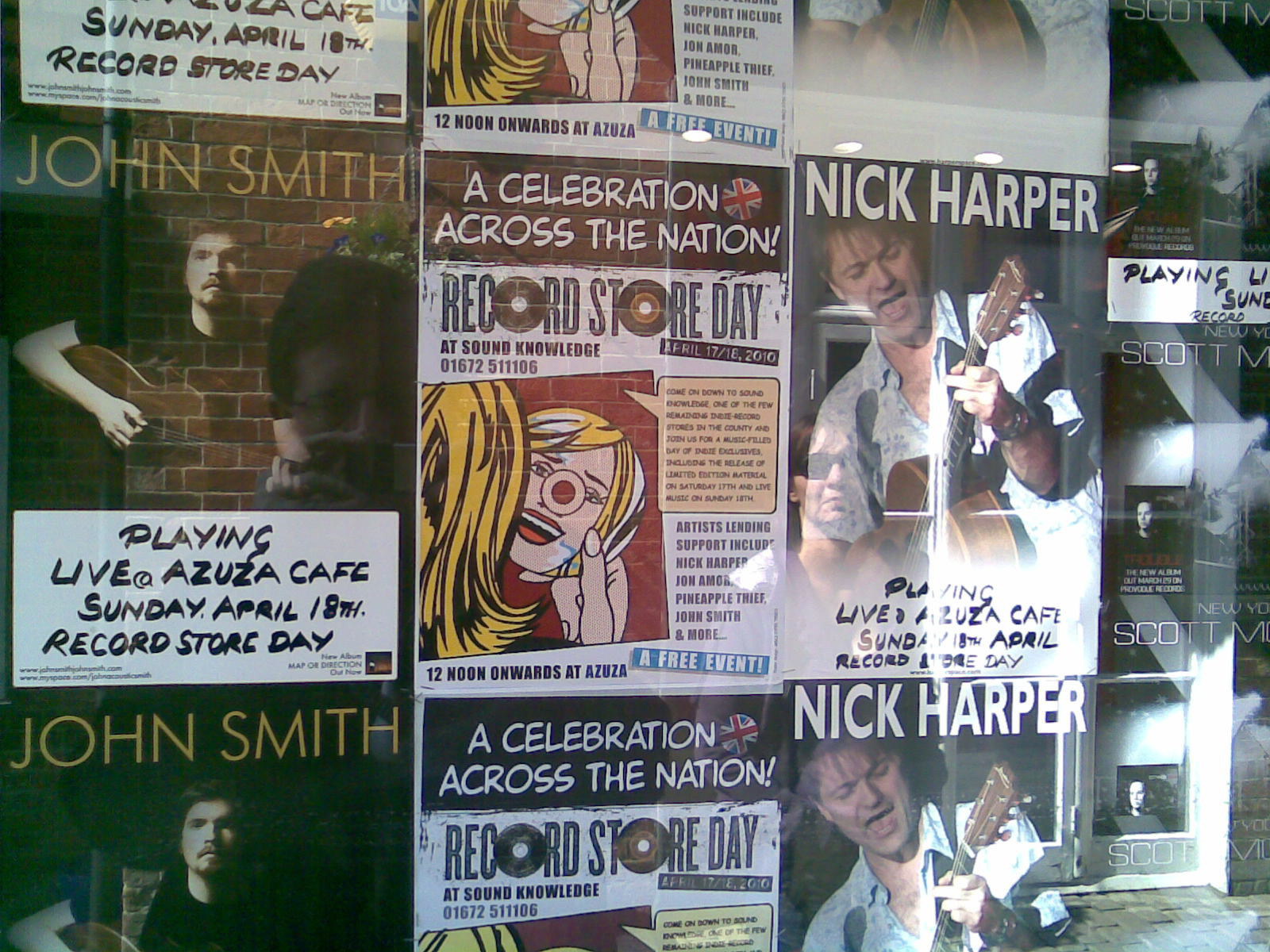
 A couple of weeks ago, son Mr P sent me a hopeful email detailing a free afternoon of music to mark Independent Record Store Day. Folkie John Smith and non-folkie Nick Harper were down to play in the pretty town of Marlborough in Wiltshire. Mr P was wondering if the family might like to go.
As it happens, I had a ticket to see Lou Reed’s Metal Machine extravaganza in Oxford on that Sunday night, so I thought, hey, let’s make a weekend of it – Saturday visiting the neolithic remains of north Wiltshire and Sunday slobbing around in Marlborough before heading off to Oxford. The family could then wander round sightseeing and grab a meal while I listened to two hours of Lou making feedback.
And so it came to pass. The weather was brilliant, the Travelodge on Saturday night was dependable and we found ourselves at some point after midday on Sunday listening to John Smith. Back in February, I made a mildly unfavourable remark on this blog about John Smith in the course of a Smoke Fairies review. Put briefly, my frustration is with artists who sign an exciting deal and get led down the road of adding a band, smoothing off the sound and becoming… well, slightly dull. That’s what I feel about his new album Map Or Direction – a lot of it is good, but not as good as he is just armed with a guitar and his great voice.
There’s a small minority of us who think many songs are best stripped down to the essentials, but I suppose the record company’s right. When was the last time someone had a hit with just guitar or piano? Hits schmits, I say… Anyway, John was playing solo, so he was as compelling as I know he can be. We got Winter, his percussive guitar wonderwork, and Hands, from his new album, followed by a couple of traditional songs. He rounded the set off with his party-piece, a toe-tapping acoustic version of Queens Of The Stone Age’s No One Knows, and finally the touching To Have So Many from his first album, The Fox And The Monk, which has just been reissued. Here’s Winter from a few years ago:
We then wandered around sunny Marlborough, along the river and into a pub, before returning at five-ish for the closing set from Nick Harper. Nick said he was feeling a bit weird, but I suspect the combination of lager and cough mixture that he was glugging liberally might not have helped.
Despite his cough, he roared through a very uptempo set, with few of his slower songs, except for the wonderful Blood Song. Aeroplane, The Story Of My Heart and Simple all ripped along nicely, and with the final three songs, Boy Meets Planet, Love Junky and encore By My Rocket Comes Fire, he was sufficiently animated to go for one of his audience walkabouts. In fact, during the second wander he jumped up on the bar and wiggled a few bars from up there. All great fun on a fine afternoon.
Once again, Nick effortlessly meshed his radical humanist philosophy into the entertainment – perhaps better than his father has often done, but let’s not get into that whole father-son thing, except to say thanks to my son Mr P for suggesting the day and emailing me the setlist just now. Older son Humungous enjoyed the show too, sitting on the floor by the front, impressed by Nick’s guitar pyrotechnics and spiky attitude. Here’s my camera-phone pic of Nick’s very own barstool blues….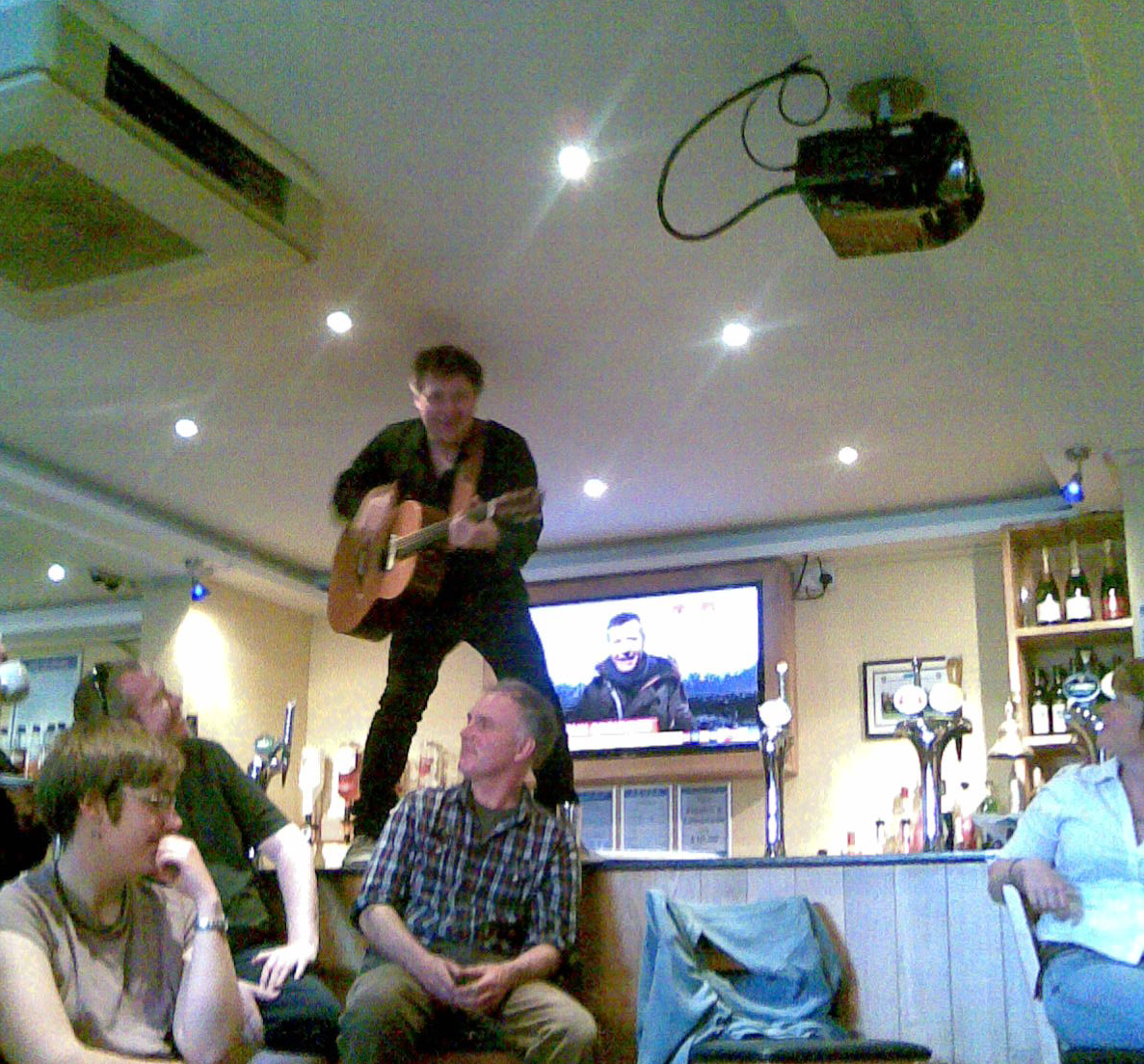
 Astral and I went round the corner to The Mag pub to see Elle Osborne, whom we’d seen play with Alasdair Roberts last month. It’s The Goose Is Out‘s smaller folk night in a room above the pub, where floor singers and players are welcome in the traditional way, and the evening kicked off nicely with various acts, including the fine hurdy-gurdy of Jess from local duo Salt and Blue.
Elle was on for two sets and covered a large range of traditional accompanied songs, fiddle tunes and a cappella songs. Her self-taught fiddle style is strong and distinctive, and between songs she talks about her background up in Lincolnshire, the folk singers she heard when she was young and some of the stories behind the songs and tunes.
One of her most affecting songs is Henry, My Son, about a young man’s poisoning. There are various versions, as there are of every folk song, but the climax leaves the listener in no doubt as to the ‘back story’ as the poor man expires:
What will you leave your sweetheart, Henry, my son,
What will you leave your sweetheart, my beloved one.
A rope to hang her, a rope to hang her,
Make my bed, I’ve a pain in my head
And I want to lie down.
She also has a number of shanties and nautical songs in her repertoire, including I Drew My Ship Into The Harbour, first recorded by Shirley Collins more than 50 years ago. In addition to some standards, such as The Wind And The Rain and The Four Marys, she sang Scottish traditional song Anachie Gordon, which tells the tale of young Jeannie, in love with ordinary fella Anachie but betrothed to Lord Saltoun. No surprises for guessing that it ends unhappily…
Elle puts on a very good show and deserves to be heard more widely. So I’ll do my bit – here she is singing Wise Eyes Wide at last year’s Brighton Festival:
 For the sake of completeness, I’m including this free gig on the blog, despite Astral’s worries that it might blow my cover as some sort of jazz cat. Indeed it’s true that I’ve been to two jazz gigs in a row, which I’m sure is a first, but it’s also not quite true that I don’t like jazz.
Like all students of a certain age back in the day, I was drawn to Keith Jarrett’s stoner Köln Concert double album and also dipped into his trio work with Gary Peacock and Jack DeJohnette (Standards Vol 1 and Vol 2). On top of that, I like Miles Davis’s Kind Of Blue and Sketches Of Spain, and have Herbie Hancock’s groovy soundtrack to Blow Up. Oh, and I saw the late great Dizzy Gillespie at the Festival Hall nearly 25 years ago…
I list these not to gain any sort of jazz brownie points – as surely most jazz fans would laugh at my hopelessly superficial appreciation – but because it’s relatively easy at my age to have accumulated lots of different bits and pieces, without having consciously put them together into some sort of coherent system. So yes, I like jazz, but I don’t like jazz.
Back to the Queen Elizabeth Hall on an early Friday evening for a free gig, and the Ivo Neame Quartet aren’t half bad – cool modern jazz, but with real chops. Ivo himself (a member of London’s Loop Collective) plays piano, but I was most impressed by his animated vibes player, Jim Hart, who wielded those sticks like a dervish. The bass player and drummer were fine too, so it was a pleasant way to see in Friday evening, pint in hand and a tap of the toe…
The Sun Ra Arkestra, Café Oto, London, April 12th 2010
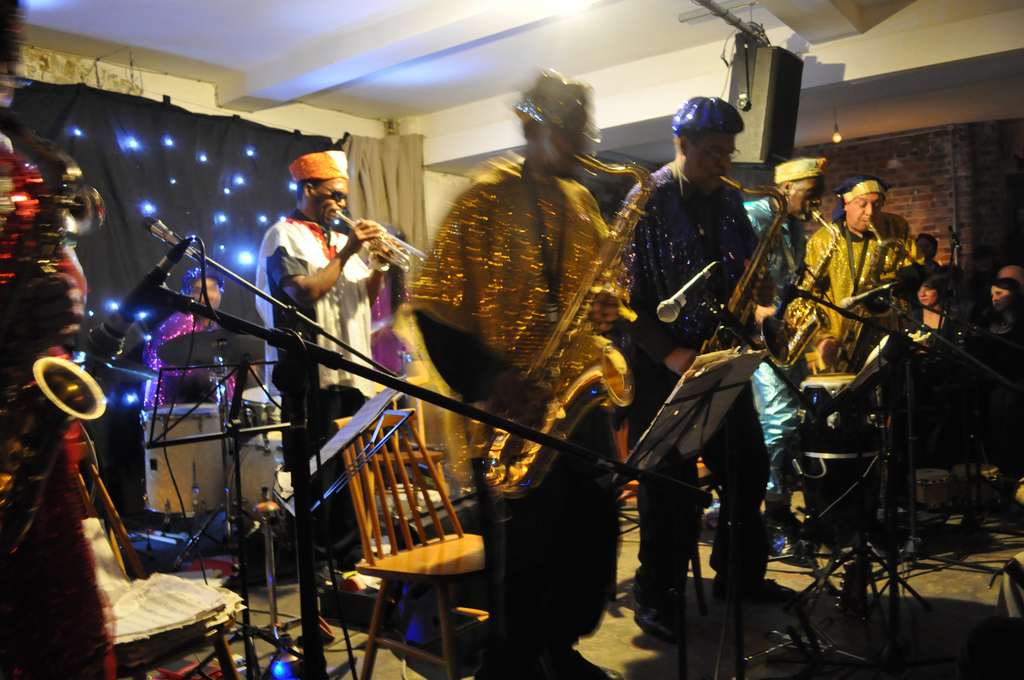 The Suit and I fancied something different and, as neither of us has a particular liking for jazz, we decided to jump in headfirst and go and see the Sun Ra Arkestra, the cosmic jazz outfit that’s been purveying strange music for more than fifty years. Since Sun Ra’s death in the 90s, the Arkestra has continued and is now under the ‘direction’ of 85-year-old saxophonist Marshall Allen.
The Arkestra had booked a three-night residency at Café Oto, which was clearly popular with the left-field jazz cognoscenti as all three nights sold out. There was a sizable queue of people waiting for returns, including louche rocker Bobby Gillespie, who needless to say blagged his way in.
The Arkestra dresses in a splendid array of shiny cosmic costumes, looking like an unholy cross between shiny astronauts, the pharaohs, 80s disco queens and Gandalf. After clapping their way onto stage, they launched into opening number Face The Music and we were treated to a full hour-and-a-half of interplanetary weirdness and wonder (I headed home before the late second set, as I was feeling knackered).
I hadn’t appreciated how tight they are as a band, or indeed how conventional some of their tunes are. In fact, I preferred the more ‘out there’ stuff to the traditional ‘Jazz Club’ stuff – more Coltrane, less Courtney Pine, as The Suit wisely said.
Of course, we got all sorts of weird bleeps, skronks and whistles, particularly from Marshall Allen’s eccentric instrument called, I believe, the EVI (electronic valve instrument). But there was also much fine percussion and horns from the enthusiastic band – great singing too. It was all very impressive and great fun. Don’t forget, folks, Space Is The Place!
 I first saw John Renbourn back in the 80s, sharing a stage with Bert Jansch at the Railway in Clapham. There weren’t a lot of people there and it seemed possible in those days that the folk-blues renaissance of the 60s was set to fade into history. Thankfully, there’s been something of a revival of their fortunes in recent years, highlighted by the rapturous reception John got from a big crowd of hairy nu-folkies at the Green Man Festival three years ago. A younger generation had rediscovered the powerful roots of their music and John seemed surprised and delighted at the reception he received at Green Man.
Interestingly, Bert appears to have prospered more from this revival – tie-ups with Vetiver, Johnny Marr, Bernard Butler and others have brought him to a new audience, and now he’s about to embark on a solo tour in support of Neil Young in the States, which will no doubt bring him more cash than he’s ever seen, which is good. John, meanwhile, continues to play in smaller venues, often accompanied by ex-Incredible String Band mainstay Robin Williamson.
The reasons for this divergence I’m sure are several, but one of them must be John’s and Bert’s different styles. Bert is at the bluesy end of ‘folk’ and his playing style at times might be called sloppy, but it has a great deal of character to it. By contrast, John has a more precise, traditional and intricate guitar-playing style, hence the ‘folk baroque’ label. His playing is less prone to errors than Bert’s, but it’s a moot point whether or not this robs his music of a distinctive character. Personally, I like his style and can spot it a mile off, but I know others have criticised his music for being rather remote.
Another reason for their difference in fortunes might be that Bert is more of a songwriter than John, who by and large plays others’ compositions as well as traditional tunes. Both of them have something of a reputation for being irascible, but Bert edges it in terms of having a stage personality and an individual voice – and people generally need a personality to hang the music off, no matter how real or otherwise it really is.
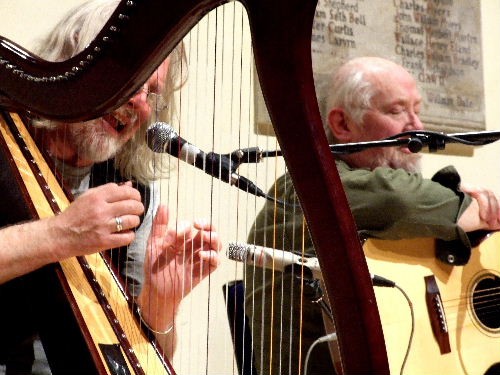 Robin Williamson has bags of personality, but he’s also perhaps an acquired taste, as were the Incredible String Band, of which he was a vital part. As Astral pointed out, he’s still a Scottish hippie at the age of 66, and the sparkle in his eye is still there, but the whimsy is not allowed to overshadow his enthusiasm and love of making music. He plays a fine harp, along with the mandolin and a series of flutes/recorders, but he has a lovable amateurishness (in the best sense) about him that contrasts nicely with John’s more sedate style, and the two kick off with a song from both of their pasts, Davey Graham’s version of Blind Willie Johnson’s I Just Can’t Keep From Crying Sometimes.
In fact, many of the evening’s songs are cover versions, but they picked some gems – including Bob Dylan’s Absolutely Sweet Marie and Buckets Of Rain, and Motörhead’s Ace Of Spades. Yes, on harp and acoustic guitar… There were also some fine traditional songs, several from the other side of the Atlantic, including Buffalo Skinners, which John had played on his 1971 album Faro Annie. First recorded, I think, by Woody Guthrie, it’s also known as The Trail Of The Buffalo and The Hills Of Mexico (as recorded but not officially released by Dylan on The Basement Tapes) and it’s a fantastic doom-laden tale of hope, greed, suffering and murder:
Well the working season ended,
But the drover would not pay,
He said, ‘You spent your money boys,
You’re all in debt to me.’
But cowboys never put much stock
In a thing like a bankrupt law,
So we left the bastard’s bones to bleach
On the range of the buffalo.
They also played a number of traditional tunes from these Isles, including The Snow It Melts The Soonest, Mull Of The Mountains and John’s wonderful historical set-piece, Franklin. This was a relaxing, enjoyable and amusing night with a couple of masters of song. Here’s a wonderful clip of John from 1979 playing The English Dance.
Bad Company, Brighton Centre, Brighton, April 10th 2010
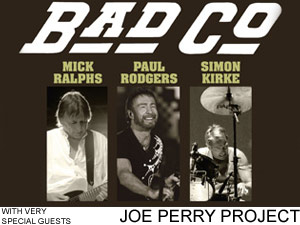 OK, sometimes a fella needs to rock – and I mean ‘rawk’ – so there we were, cruising down the M23 to Brighton on a sunny Saturday afternoon, Bad Company blasting from the car stereo like it was 1976 all over again. The Browne Bluesman and I agreed that Bad Company’s appeal was that they were ‘no frills’ – just solid blues-rock, with great riffs, memorable songs, fine singing and no squealing guitar solos or annoying pomp. And that means Bad Company’s music had lasted pretty well, unlike most heavy rock bands from that era or – heaven forbid – the 80s. Less is usually more, in rawk as in life.
The FA Cup semi-final went as badly as we’d feared, particularly with The Suit jeering on the sidelines, so we were very much in the mood for some plain old fun. By the time we’d got to the Brighton Centre, the Joe Perry Project were near the end of their set, which wasn’t too much of a shame, to be honest, though it was nice to hear Walk This Way played by the man who wrote that riff.
When Bad Company took the stage and launched into Can’t Get Enough, I suggested to my second-row compadres that we rush for the rail… so we did, all the better to nod our heads, whoop and generally rock out. Paul Rodgers was leaping about the stage like a man possessed and he certainly seemed to be geeing up Mick Ralphs, who was somewhat hesitant for the first couple of songs, but Rodgers’ enthusiasm soon got the better of Ralphs too.
We were treated to most of the rocking classics – Rock Steady, Run With The Pack, Rock ‘N’ Roll Fantasy – as well as the slower numbers like Seagull. Sadly, they didn’t dedicate it to the local football team, which would have pleased the crowd, but it was nicely done. It did set me thinking (not that you do a lot of that at a Bad Company gig) about ordinary English blokes making rock ‘n’ roll in the 60s and 70s. Most of them came from humble enough backgrounds and I suspect that we sometimes forget these days just how exotic America was back then – certainly when they were growing up in the 50s. And American ideas of freedom (sexual and otherwise) must also have been something exciting. Seagull sings of this sense of freedom and escape:
Seagull, you fly across the horizon
Into the misty morning sun.
Nobody asks you where you are going,
Nobody knows where you’re from.
It’s quite a long way from Dylan, let’s be honest, but I admire the fact that a lad from Teesside looked further than just at the chance to work in an ICI factory. It’s not complicated, but it is truthful.
Anyway, that’s enough analysis, let’s boogie… and Feel Like Makin’ Love got the big cheer it deserved, though I was slightly disappointed we didn’t get that fine solo from Ralphs which is on the harmony rather than the melody, but I sang along with the rest of them. Shooting Star was similarly received, to a backdrop of photos of rock ‘n’ roll’s victims, including the great Paul Kossoff, Rodgers’ and Kirke’s companion in the wonderful pre-Bad Company band Free.
Pugnacious D was standing next to me by the rail and started getting hassled by some drunk woman and her annoying boyfriend/husband/parole officer. I leaned over and said, ‘Don’t push. He’s been here rocking out to Bad Company all night, OK?’ I should have added that you don’t mess with the Pugnacious one, despite his deceptive stature…
Joe Perry came on for the encore, a rousing Bad Company, and seemed genuinely delighted to be playing with the band. And as my crappy camera-phone photo shows, Paul Rodgers was grinning like an idiot too. A very enjoyable show, after which we headed out into the Brighton night, for a session at the Hop Poles, an overcooked pizza and more shenanigans in the hotel bar involving a large bill and a tipsy policewoman. Now that’s rock ‘n’ roll.
The Triffids, The Barbican Centre, London, April 9th 2010
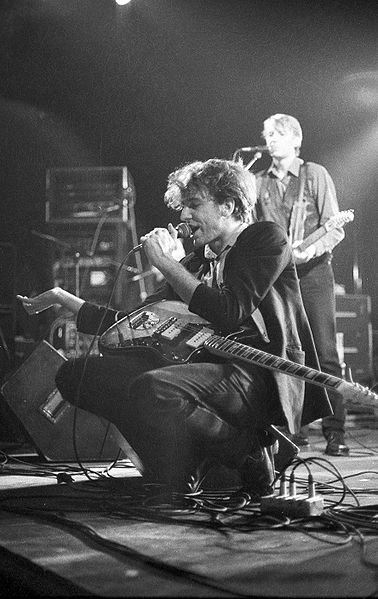
The Triffids, 1985
The mid-80s were ‘dark’ days for those of us who like rock ‘n’ roll or pop or call it what you will – essentially that music which germinated in the 50s, flowered in the 60s and threw forth interesting seeds in the 70s. Alas, by the 80s, the money-men were well and truly in charge and most ‘rock’ music on the radio, in record shops and live on stage was dire. Despite what entrepreneurial gurus will tell you, business is full of ‘me too’ copycats, while young people’s music should be all about risk-taking and innovation. So that’s why we got Kajagoogoo, Billy Idol, U2, Simply Red, Dire Straits and all the rest of that ghastly crowd.
By 1985ish, I almost despaired of hearing much great new music again and even Neil Young was languishing in his Geffen-imposed exile. Granted, REM were still cool, Sonic Youth were on the radar and there was quite a lot of good stuff on the edges of the indie C86 scene, but the live music I gravitated to seemed to be predominantly Anzac – bands like The Go-Betweens, The Moodists and Hoodoo Gurus from Oz, and The Chills, The Clean, The Bats and The Verlaines from NZ. Many of those bands moved to London to ‘make it big’ and they bought with them a freshness and enthusiasm that was sorely lacking on the home front.
My favourite of those Down Under bands was The Triffids, a close-knit group from Perth under the leadership of singer and songwriter extraordinaire David McComb. I’d heard a few of their singles on John Peel, but it was their ‘breakthrough’ album Born Sandy Devotional (recorded in ’85, released in ’86) that absolutely captivated me. That title alone deserves an award. And the music was big – ambitious and expansive, yet closely personal and dripping with truth.
The Australian desert and the outback itself seemed to imbue the songs with a grandeur and bigness that was unique, though the music never veered into pomposity or stadium anthem territory – Oz band INXS sounded similarly ‘big’, but they were crap. Two other great albums followed – In The Pines and Calenture – but I lost touch with The Triffids after that. The late 80s saw a revival of good music (spearheaded by the Pixies and a rejuvenated Neil Young, who was soon to be crowned the Godfather Of Grunge), and The Triffids fell off the radar altogether.
It was only in 1999 that I heard of them again, and it was in desperately sad circumstances – the death of founder member and cornerstone of the band, David McComb. The band had split up in 1990, in fact, but David had continued to write and perform, despite continuing drug problems which ultimately resulted in him having a heart transplant in 1996.
Two years ago, the remaining members of the band gave a series of performances at the Sydney Festival and it was this show – A Secret In The Shape Of A Song – that was being put on at The Barbican, to what seemed like 1,500 middle-aged Aussies and me.
The Blackeyed Susans were billed as support, but the MC came on to say that they preferred to all play together as The Triffids – and to play for three hours. The backdrop spotlighted a slideshow of snaps from the McCombs’ childhood (brother Robert plays guitar and violin in the band) and from the band’s early days. First on, though, was Dev Hynes, aka Lightspeed Champion, who played a couple of songs to get us in the mood. The band then took to the stage and treated us to a wonderful selection of numbers from throughout David’s career, but unsurprisingly it was the songs from the ‘big’ albums that got the greatest applause. One such number, Tarrilup Bridge, featuring the vocals of keyboard player Jill Birt, is a spooky tale of stardom and despair:
Yes I was your best friend,
You were my blinding sun,
Now the only thing bright is my name in lights
And the night has only just begun.
I packed my bag,
Left a note on the fridge,
And I drove off the end of the Tarrilup Bridge…
One problem I thought the band would have is replacing David McComb’s powerful vocal style, and band members Robert McComb, mainstay Graham Lee and some other guest singers weren’t quite up to it, though The Seabirds and Life Of Crime were both performed with energy and drive. Blackeyed Susan singer Rob Snarski has a great voice, however, and filled in very well on some of the quieter, more soulful tunes, but it was guest vocalist Simon Breen who nailed the McComb sound with spellbinding versions of Trick Of The Light and Lonely Stretch.
Dev Hynes reappeared to join the band for fine versions of early tunes Reverie and Beautiful Waste, while Tindersticks’ Stuart Staples came on to sing Wide Open Road – screwing up the lyrics in the process. Not forgivable, really, for such a great song. Calenture‘s Bury Me Deep In Love – immortalised as the song played at Harold and Madge’s wedding in Neighbours (!) – sounded lovely, while some of the bands earlier tunes took their place as fine songs, too.
The evening wrapped up with a guests-‘n’-all version of Fairytale Love and I felt we’d been treated to a fine memorial to David and his work – big, bold and truthful, but tinged with sadness and a whispering sense of loss and loneliness. Below is the majestic Wide Open Road featuring David in all his glory and if you haven’t got Born Sandy Devotional, go and buy it here.
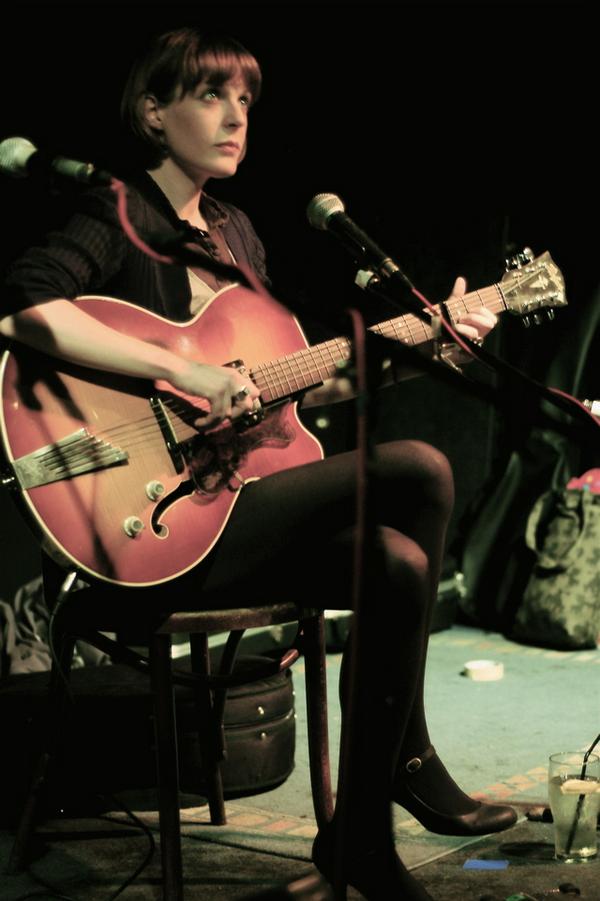
Mary Hampton
Harpist and singer Serafina Steer was at Café Oto to launch her new CD Change Is Good, Change Is Good, supported by left-field Brighton-based folk singer Mary Hampton and some bloke calling himself The Devil. I hadn’t seen Serafina for a couple of years, but had enjoyed her off-kilter little songs and fine harp-playing, so I was looking forward to an evening of slightly twisted acoustic song-making.
Mary Hampton came on, illuminated by the most in-your-face lightshow I’ve seen for a while, courtesy of Bubblevision – lots of op-art stripes, coloured bubbles, liquid light and swirly oils. She plugged in her Dobro and launched into two traditional folk numbers, Benjamin Bowmaneer (a surreal old tale about a tailor who takes on a flea) and saucy song The Bird In The Bush made famous by Anne Briggs. Mary plays well and sings in a very clear and attractive voice, not quite with the purity of Anne Briggs, but then no-one else does. She then played two of her own compositions, Because You’re Young and the hypnotic Island, accompanied at her request by the gentle jangling of the audience’s house keys. The effect of this, coupled with the crazy lighting, was quite hypnotic and for a moment I thought I’d been transported back to the psychedelic world of Joe Boyd’s UFO Club – minus Joe Boyd, thankfully.
She finished with a fine piano song, which I believe was called Hoax And Benisons, but what followed – the arrival of annoying guitar-playing ‘singer’ The Devil – threatened to derail the whole evening. As my gig companion the Amber Stalker drily commented, ‘If he’s The Devil, then Robert Johnson got the best of the deal…’ I suppose this comes under the heading of ‘performance art’, but mostly it was just annoying noise.
Serafina took the stage to a huge cheer from her mates and seemed quite nervous to be hosting her own CD launch. Throughout her set, she was assisted by friend Polly (and sometimes Alice) on backing vocals and Olivia Chaney on harmonium. She seemed more confident with her older songs, notably early single Peach Heart and Uncomfortable from her 2007 CD Cheap Demo Bad Science, but much of the new album’s songs were attractive too – particularly Port Isaac and Motion Pictures (no, not the Neil Young song).
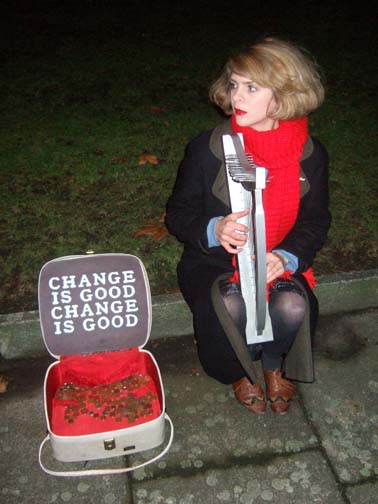
Serafina Steer
Her harp-playing is accomplished and, at times, dazzling, but nerves seemed to be getting the better of her tonight. I imagine with all that meeting-and-greeting, she was somewhat distracted, but her disarming humour kept the audience smiling throughout. She also attempted a few songs on keyboard/synth, including a half-spoken half-sung Raymond Carver poem Drinking While Driving, which was good.
Serafina is phenomenally talented (first class music degree, collaborative study with Ravi Shankar…) but perhaps isn’t always on top of her game when performing in front of a crowd. That’s only a minor reservation, as I really like her eccentric sound, her skilful playing and her determined attitude. There were times tonight, though, when it seemed like we’d gatecrashed a raucuous house-party for her and her friends.
 I don’t often mention the support acts in this blog, but that’s usually for lack of time not because I don’t care – earnest listener that I am. This occasion, though, was almost a double bill for me as I’d seen Oregonian Laura Gibson at last year’s End Of The Road Festival and was very impressed. I missed her show at The Windmill in Brixton earlier in the year, so was keen not to miss out this time.
Parky had gone on ahead to buy me a Newcy Brown, but I missed the first song thanks to the world’s slowest girl on the door and being inexplicably locked out of the club for five minutes. Not good. After settling near the front, I stood admiringly as Laura played an excellent set, accompanied by two accomplished chaps on a huge range of instruments – drums, glockenspiel, keyboards, trumpet, bells, pedal steel played with a violin bow, melodica and more. She plays a simple acoustic guitar with nylon strings giving her sparse picking style a Spanish edge.
The first thing you notice about her songs is how precisely the words are enunciated – and how well-chosen those words are. There’s nothing obviously complex about them, but her lyrics have a striking timelessness to them that defies easy categorisation. I suppose you could say Laura’s a folk artist, but there’s a whole lot more going on. And her singing voice is great – at times she can veer towards the ‘girlie’ sound of every other indie girl singer on the radio, but she has a resonance to her voice that reminds me of the great Karen Dalton. Not as ‘deep’, but almost as beguiling and austere.
Stand-out songs were Sweet Deception, which started ‘rocking out’ very nicely, and the bewitching Funeral Song, both from her excellent CD Beasts Of Seasons. She’s playing with Woodpigeon at the Union Chapel next month, so I’ll be sure to check her out again. I gave her a quick ‘hello’ after the show and she said that she really liked playing at The Windmill and had indeed met Angry Dog…
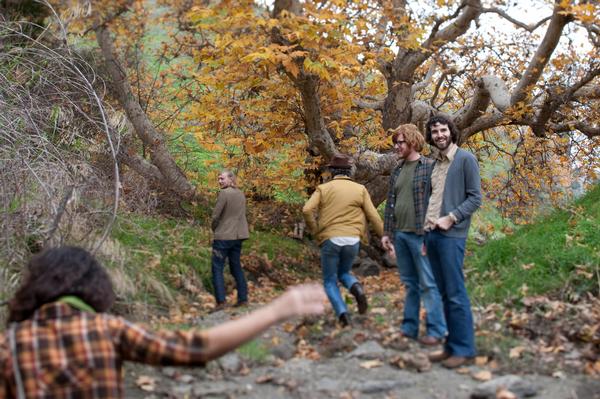 I enjoyed Port O’Brien‘s 2008 CD All We Could Do Was Sing, but this was the first time I’d seen them. They have a very ‘fluid’ line-up – anywhere between three and six of them can turn up. This time, female member Cambria Goodwin didn’t make the trip with co-founder Van Pierszalowski and Ryan Stively. Oh, and their drummer and electric guitarist failed to make the trip to Europe either, so Van told us an amusing tale of grabbing a drummer in San Francisco and Skyping a guy called Nikolai who they’d met in Norway, both of whom said they’d be happy to tour Europe.
That confusion might explain why much of tonight’s set was rough around the edges, but that’s good. We don’t want Fleet Foxes, thank you, and much of their set was rockier and grungier than their studio stuff. Indeed, the first three songs, including a heavy Don’t Take My Advice, reminded me of the slow rock of Crazy Horse at their stonedest. Very nice. Fisherman’s Son highlights the nautical flavour of much of their work – Van’s parents met at a cannery in Alaska and he himself has spent months on boats in the high Arctic – but some of the softer songs on record, with almost shanty-like harmonies, lost some of their punch this evening. The contest perhaps wasn’t fair, as with this line-up the louder numbers won out every time, including Calm Me Down, Stuck On A Boat and the excellent Pigeonhold.
Occasionally, their songs can be a bit too indie for my tastes, with the choppy-poppy guitar beloved of bands who think it’s 1981, but they’re young, so who am I to complain? I was aware that their final song, I Woke Up Today, had been a single, but I hadn’t bargained for the outpouring of enthusiasm and singing along that greeted it. Again, it sounds too ‘NME’ for me, but the rockier encores ensured a fine ending to a very enthusiastic and fun show.
Veteran music journo and Uncut editor Allan Jones seemed to enjoy it too, as this was a Club Uncut evening. Previous Uncut events have been ruined for me by loads of loud, uninterested hangers-on floating around Mr Jones hoping to be noticed and doing the schmooze thing, but thankfully tonight the wannabe Nick Kents kept quiet and enjoyed the show. Here’s the official video for Stuck On A Boat:
Circulus, Dog Roses, Holloway Jug Band, Chicken Shed Zeppelin and more
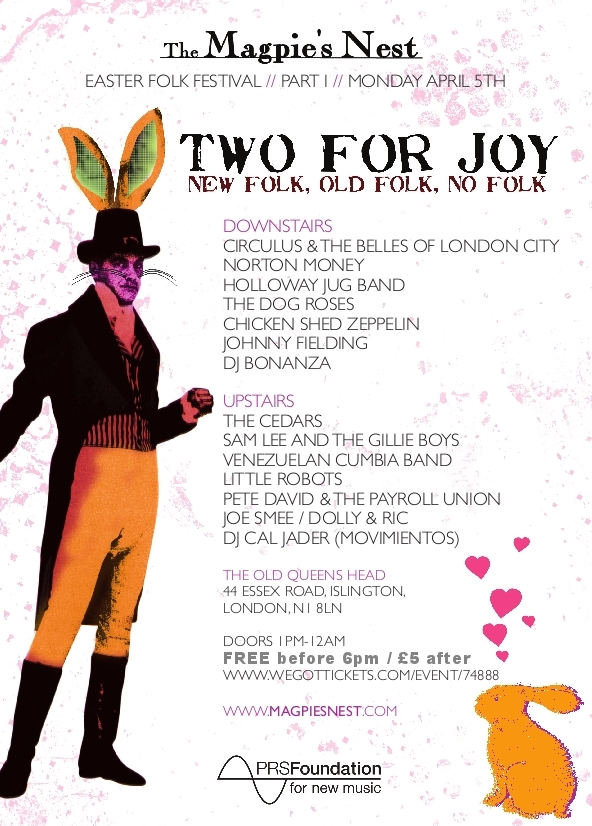 This ‘all-dayer’ was listed as kicking off at one o’clock, but there was no way Astral, The Suit and I were going to drink cider for quite that long, so we turned up at four-ish and found the downstairs bar packed. With some judicious moving and manouevring, we grabbed ourselves a high table, all the better to enjoy the afternoon’s shenanigans.
The band that were on as we arrived were a competent enough young bluegrassy Americana combo, complete with rustic beards and clothes straight out of Deadwood, but the whole was less than the sum of the parts. We didn’t catch their name (rule number one of live music: let people know who you are), but they had quite a following, particularly of young women.
Between bands, Astral and I speculated on the fact that the primary purpose of joining a band (for young men at least) is attracting the girls, and on that score they seemed to be doing quite well. It also suggests that there’s something of a bluegrass revival going on among the indie kidz, which is welcome, but you just know they’ll move on like a herd of savannah-grazers in just a few months – probably post-festival season.
 Next on were my band of the day, Brighton-based Chicken Shed Zeppelin, who weren’t as young as the previous band, but who played a mean set of radical-edged bluegrass – they could have been called The Coal Levellers. I knew we were in for an old-fashioned socialist-revivalist occasion when I read the fiddler-singer’s F*ck the Olympics t-shirt. The set comprised their own numbers, some bluegrass classics and some other songs suitably bluegrassed up – notably a rip-roaring Fulsom Prison Blues played at a breakneck speed. Very good fun indeed.
Dog Roses were another dapperly dressed young band ploughing a similar Americana furrow to the first lot and I begun to wonder if ‘Folk Festival’ wasn’t something of a misnomer. I’m all for broadening the definition of ‘folk’ to cover lots of demotic musical styles, but it does tend to get applied willy-nilly these days to bands who either have acoustic instruments or play old-style music or both. The bill at Moseley Folk Festival later this year, for instance, bears witness to this drift. In any case, Dog Roses were OK but nothing special, and Astral and I knowingly agreed that their fiddler was in fact a violinist – and there’s a bigger difference than some might think.
After another break and another opportunity to down more cider, things were getting slightly raucous but still good-homoured as the Holloway Jug Band took to the stage. And again, they were OK, but nothing stood out – even the jug-playing was somewhat subdued compared to the enthusiasm of the rest of the band. If I’m going to watch a jug band, I wanna hear some damn fine jug-playing, thank you very much….
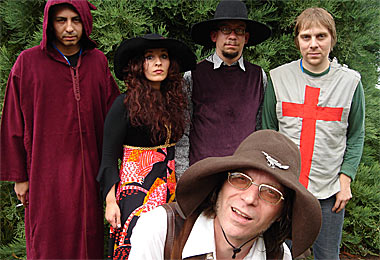
Circulus – ridiculus?
At this point, we took off to the upstairs bar and found a welcome comfy sofa to park on. The promise of bands playing each stage once so that you wouldn’t miss them didn’t completely materialise, though I did enjoy Chicken Shed Zeppelin again. It meant that I was likely to miss most of Circulus downstairs but somehow the stars weren’t aligned correctly tonight for me to enjoy their ‘tripped-out prog homage to both ’70s psych and 12th-century chamber music’. In fact, I ran away upstairs again. Circulus – you either like ’em or hate ’em… or possibly both.

 A Gig's A Gig
