 The lovely people at Folk Against Fascism were holding their ‘Village Fete’ at the Southbank before the evening’s gig, but the wet English weather conspired to force us indoors to enjoy the Oysterband’s ceilidh, followed by various episodes of Morris action and beer-drinking. Astral pointed out the pervading smell of cider, so we must have been in a minority. It was an entertaining afternoon and then, after a swift pizza, it was off to the auditorium for the main event.
Things didn’t start well, as singer Jo Freya came out to welcome us, outlining the resistance to fascists aligning themselves with folk music and then ruining it by saying how excited she was that her mother, a long-time Tory voter, was going to vote Labour in the upcoming election. [Sigh]… I’d really like to know why that’s relevant to Folk Against Fascism. Daily Mail-reading old folkies might be annoying (and they usually are), but their voting Tory is not a fascist act. We’re not all knee-jerk lefties, you know.
Perhaps Jo might like to know why I have no intention of voting Labour – here are a few reasons, based on the actions of the Labour government: illegally invading Iraq, initiating ID cards, promoting 28-day detention, turning a blind eye to rendition, preventing the investigation of massive corruption involving BAE, replacing Trident, abolishing the 10p tax rate, presiding over a greater wealth gap than the one they inherited, having their snouts in the expenses trough, failing to regulate the financial industry even after bailing out the banks…
I could go on, but we’re here for the music. Before Chumbawamba came on, young singer and fiddle-player Jackie Oates took to the stage for a solo song, and then the band gave us an entertaining set without too much of the annoying trad-rad ranting with which I (perhaps unfairly) associate them. Torturing James Hetfield is an amusing song in response to the Metallica front-man’s approval of the band’s music being used to torture inmates at Guantanamo. Dance, Idiot, Dance is their reaction to the BNP’s attempts to ‘reclaim’ folk music, plus, as the band say, it’s a lovely opportunity to ridicule the neo-fascists while rhyming ‘cold lasagne’ with ‘Britannia’.
OK, last bit of party politics coming up… Their blog is very refreshing on the reasons for not voting at the forthcoming general election, so I’ll quote it without comment (but, as you’ll guess, tacit approval):
People worked, fought (and some died) for the vote. But they did it because they wanted it as a right, not an obligation or a duty. As a right to be used wisely and sensibly. Right now we live in a country where cynicism of the major parties is at an all-time high; understandably so. Basically, they’re all crooks, the lot of ’em. Why shouldn’t I have the right to refuse to support any of them? Why should I have to demean my intelligence, my work and my ideas by thinking that by putting my cross in a box I am suddenly A Participant In This Democratic System?…
There’s an awful lot of ground between “Can’t be bothered to go down the Polling Station” and “People fought for the right to vote. It’s my duty!” An awful lot. It’s in that space that campaigns can be fought, laws can be made and broken, communities strengthened or crushed. And it’s in that space where the real stuff happens.

Show of Hands
Working in the rain cutting down wood
Didn’t do my little brother much good,
Lost two fingers in a chainsaw bite,
All he does now is drink and fight,
Sells a bit of grass, hots up cars,
Talks of travel, never gets far,
Loves his kids, left his wife
An everyday story of country life…
Meanwhile Roots more controversially tackles perceived cultural desolation head-on:
Rule Britannia or Swing Low…
Are they the only songs we English know?
Seed, bark, flower, fruit,
They’re never gonna grow without their roots,
Branch, stem, shoot,
They need roots.
And everyone stares at a great big screen,
Overpaid soccer stars, prancing teens,
Australian soap, American rap,
Estuary English, baseball caps.
Hmmm, there’s a danger here of them not only sounding like saloon-bar whingers, but also of getting the facts wrong. The English peasantry was uprooted and urbanised a long time ago, so the process of stripping away of roots has been going on a lot longer than the song might suggest. What’s more, Roots speaks approvingly of the ‘Afro-Celt’ penchant for singing, dancing and telling stories late into the night. ‘Afro-Celt’ is an unfortunate phrase in suggesting an obvious fraternal link between two broad cultures, but the endemic racism suffered by two Afro-Celts I know about in some detail – Phil Lynott and footballer Paul McGrath – suggest a less happy link. And in my experience Irish bars are more likely to be filled with American music than Irish music, so Show of Hands’ cultural complaints have a wider significance than perhaps they admit.
The homogenisation of modern Western multinational culture affects us all, so let’s get on with belting out those traditional songs too – talking of which, they did fine versions of Adieu, Sweet Lovely Nancy and The Keys Of Canterbury, while Santiago was a touching tribute to Chilean political exiles. Sam Lee joined them for a couple of songs, while Tim van Eyken performed in the solo slot before Bellowhead came on.
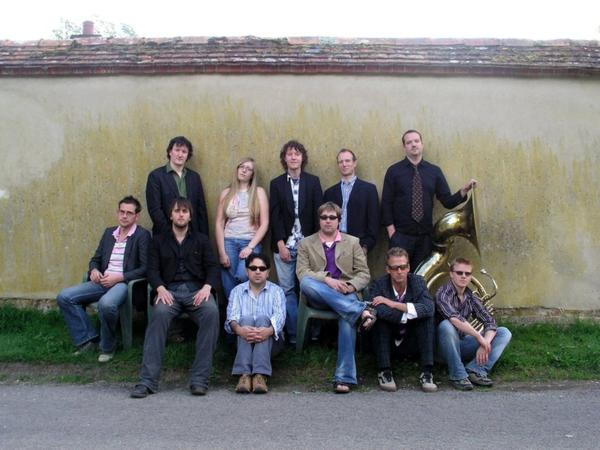
Bellowhead
So a mixed evening overall, with my political hackles raised, though they were smoothed down by a swift final pint with Astral, the Browne Bluesman and Mrs B in The Wellington next to Waterloo. That pub’s fine painted ceiling, showing scenes from the Battle of Waterloo, is a reminder of an older English nationalism, and our modern nervousness about such military triumphalism is, in my eyes, a good thing rather than a reason to want a more confident and perhaps arrogant identity. Long live English unease!
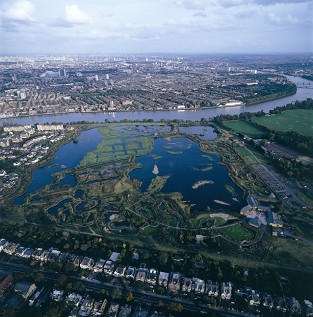 This blog is billed as ‘A year of live music in London and beyond’, so here’s a musical change of perspective for you – the dawn chorus, given to us by Mother Nature for free rather than promoted by Live Nation (plus booking fee). I get a great deal of pleasure out of birdwatching and now’s the time of year when one of the natural wonders of the world is upon us. All northern hemisphere birds are now breeding or about to breed, so birdsong is at its height and the best time of day for hearing it is as the sun comes up.
The London Wetland Centre is on the site of the former Barn Elms reservoirs in southwest London and over the last ten years and more it’s been turned into an oasis for wildlife in the heart of the city. We visited back in the winter to see the rare bitterns that were wintering there, but now that spring has sprung, I wanted to get out there and hear the symphony of sound.
As I left the house at just after four in the morning, blackbirds were already singing. Paul McCartney got it right with ‘Blackbird singing in the dead of night’ – they do indeed sing all night long sometimes and are always the overture to the full dawn chorus. By the time I arrived at the Wetland Centre at 4.45, they’d been joined by robins and, to my surprise, a solitary lapwing.
Next to join the chorus were great tits, wrens and woodpigeons. By this time, it was possible to tell where particular birds had their territories, such was the density of singing among the willows and scrub. And then the lovely tune of the blackcap struck up. It’s just about the most ‘melodic’ song of any British bird, barring the elusive nightingale, and got a mention in the wonderful song Commune by Roy Harper, himself apparently something of a birder.Near the extensive reedbeds, the water-loving birds started up – sedge warblers, reed warblers and reed buntings – all the time ‘backed’ by squawking moorhens, coots, ducks and geese. Then in the thicker bushes, it was good to hear the explosive song of a Cetti’s warbler and the simple refrain of a lesser whitethroat.
After a reviving coffee and a veggie sausage sandwich, it was off again round the back of the lagoon and nearly all the other birds had joined in the chorus – blue tit, chaffinch, greenfinch, dunnock and more. It was now getting hard to distinguish individual songs from the ‘ensemble’, but it’s a pleasure just to listen and not ‘dissect’. It’s interesting that even birdwatchers find it difficult to describe a lot of birdsong – ‘It’s a sort of metallic wheezing sound, with a reedy trill at the end…’ – which is not much different from trying to describe human-generated music. Very often, there simply aren’t the words, but the unattributable quote ‘Writing about art is like dancing about architecture’ expresses this thought too strongly. There are things you can say – and write – about music, but sometimes silence is golden. Sit back and listen to two minutes of the dawn chorus as recorded in the New Forest.
Träd Gräs och Stenar and Voice Of The Seven Thunders, The Luminaire, Kilburn, April 30th 2010
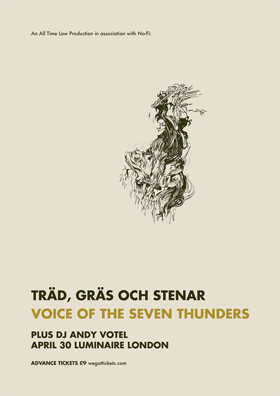 Voice Of The Seven Thunders is the alter ego of Mancunian guitar-picking wiz Rick Tomlinson and his sometime band-mates. Previously called Voice Of The Seven Woods, he’s always impressed me, not just with his Fahey-esque ‘American Primitive’ style, but also with his slightly ‘f*ck you’ attitude – you know, that Mancunian slackness when you’re not quite sure if they’re being offhandedly rude to you… It normally riles me, but in the world of acoustic guitar playing it’s strangely refreshing. Anyway, he started his set (very late as it turned out, allowing The Suit and me to enjoy a few extra Sierra Nevadas), picking a fantastic solo path through a folk-drenched semi-improvisation which turned into a raga-tinged acoustic epic as he exploited the modal tuning for all it was worth, bringing forth mysterious drones, ominous runs and beautiful flights of fancy, aided by lots of loops and delays. Very fine indeed.
He then invited his band-mates on stage, including Keith Wood from Hush Arbors, whose birthday it was (no song, though) for half an hour of thrilling, driving, droning psych-folk-rock. I was somewhat familiar with this material, which was mostly from the new album, and I’d seen him support Six Organs Of Admittance last December, but tonight I was mightily impressed by the power the four of them generated on stage – very tight, but with enough digressions and holes in it to be continually fascinating. You should go and them or, at the very least, buy or steal the album. I’d previously thought that changing his/the band’s name had been a capricious whim, but there’s some sense to it. His first album had been much more acoustic (and solo), even though he was fond of his loops and feedback, so Voice Of The Seven Woods was appropriate then, while now ….Thunders is just right, suggesting the ominous excitement of a storm in full flow.
After about twenty minutes’ break, the old fella with crutches who we’d seen near the merch earlier took to the stage and started fiddling with the bass amp. It turned out he’s the bass player with Träd Gräs och Stenar, which goes to show we’re dealing with a band with a serious history. The name is Swedish for ‘Trees, Grass and Stones’ and their website describes what they do as ‘Swedish natural music, improvised and boundless’. They grew out of the late 60s counter-culture and have been described as ‘prog’, so it’s a miracle I’m here at all – if you’d told me I’d be going to a gig by a Swedish prog-rock group, I’d have run screaming out of the room, but thankfully these days we have the Internet. When I saw them listed on the Luminaire’s website, I was curious, checked out their MySpace page and loved what I heard – a laid-back but driving psychedelic soundscape, with none of the annoying twiddles, bombastic sweeps and pointless key-changes that infest ‘prog’.
Here’s how Psychedelic Magazine described their origins:
Long tours in Scandinavia, mostly outside the established channels. The band was trying to create a free and co-creating situation through the music, dance, light show of slides and film, serving food and letting people play on instruments they brought with them. They were participating in actions people did to change their common situation. They lived like their audience. More – you are the music, we are just the band, the Spela Själv (‘Play It Yourself’) movement.
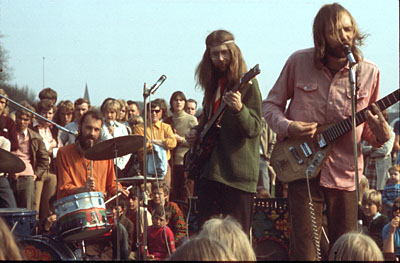 How genuinely cool is that? And check out this photo of them (left) in Copenhagen in 1971. Ah, I can just smell the cheap hash and the damp Afghan coats… Meanwhile, back at the Luminaire in 2010, they began their set with a slow burning drone, adding layers on top until it pulsed to a fine conclusion. Next was one of the songs I’d liked on their MySpace page, Punkrocker, although they don’t really do many songs as such – and it isn’t a punk rock song, though I can see the sympathies they must have had with that ‘movement’ in the late 70s. Their longevity compared to punk, however, must be down to the relative simplicity of their improvisations, giving them a timelessness that’s not quite rock, not quite blues and not quite folk. They’re keen to tie their music to Sweden, though, and introduced the bracing tune Polskan as a variation on a lively Swedish dance.
They also described one song as a traditional nursery tale, but it sounded to me like a long and fine sonic guitar exploration, showing that they have a lot in common with Voice Of The Seven Thunders in their love of slowly unfolding sounds and droning beats. What’s more, they lasted well past by bedtime, despite their advancing years, so I made my excuses and left, impressed by an evening of fine music.
 Another quick review for completeness’ sake – and another jazz gig. This is becoming a habit… Anyway, I met up with Mr P at the Queen Elizabeth Hall (Theakston’s for me, Coke for him) and we thought we’d listen in to the free Friday six o’clock show for a while before going our separate ways.
Frøy Aagre is a Norwegian soprano sax player, and very accomplished she is too. And something she has in common with Jim Moray (see last Sunday’s review) is that both of them studied at the Birmingham Conservatoire. Frøy, however, has jazzier fish to fry with her quartet (drums, bass and piano) and is back in the country promoting her new album Cycle Of Silence.
I can’t say I noticed anything particularly Nordic about the music, but it’s certainly at the more European and modern end of the jazz spectrum rather than the older, more African end. Pleasant melodies, rippling rhythms and interesting variations rather than showy solos were the order of the day and I enjoyed it. Then it was off to see some fellow Scandinavians, the 60s free musicians of Träd Gräs Och Stenar at the Luminaire, more of which soon…
 I’ve enjoyed hearing Sam Carter play live on several occasions, most recently at the Memory Band gig at the same venue, but it was the Browne Bluesman and Mrs B who persuaded me to go to this one. They played his 2009 CD Keepsakes in the car on the way back from Brighton the other week and I was very taken with it.
26-year-old Sam is something of a rising star, having been tutored by the great Martin Simpson, and he justly won the Horizon Award at this year’s prestigious Radio 2 Folk Awards for best emerging artist. The Slaughtered Lamb was busy but not full to see him up close.
He started with a gentle a cappella song, called The No Testament (thanks to Sam himself for the info!), that shows his fine, slightly melancholic, voice. ‘Pastoral’ his solo style might appear, but the next song, Yellow Sign, proves that he’s resolutely urban too. Sam’s lyrics here show a piercing eye for life in modern deprived London:
On a November day in an East End cafe
There’s a fight kicking off to the right of me
‘Well I’ve half a mind to hurt you,’ he cries
‘But I don’t want the world and his wife to see.’
And he’s dragged that girl outside
With his arms around her,
There’s a yellow sign
Where they found her.
He softens again for the next number, Spill Those Secrets, a revealing and intimate song, while the next tune, Hired Hands, details his anger at his uncle losing his job in the recession. Sam’s ability to juggle the private and the public, the hard and the soft, is admirable, while the next song, Here In The Ground, is almost heart-breaking in its directness and honesty, concerning as it does the death of his sister. As Sam said (and I paraphrase), ‘Songs should tell the truth about the way people live,’ which should be sprayed on the walls of recording studios up and down the land when gel-haired indie boys straight from stage school swagger in wanting to be the Next Big Thing.
Matt Ridley on upright bass joined Sam for Station Road and then the nakedly personal She Won’t Hear:
Carrying a suitcase from the car across the drive
And I’m bending over backwards just to keep her hopes alive.
Is it worse to let it happen or to engineer the fall?
Moving in together has made this house so small.
The two of them were joined by Sam Nadel on drums for Pheasant, with it’s great line, ‘You flatten me like a pheasant on a country lane.’ Sam was wearing his Folk Against Fascism t-shirt and briefly but eloquently explained why, before singing Bones:
Yet I’m in no rush to get away before the ship goes down,
The first of us to jump is just the last of us to drown.
After the relative gentleness of Dew and Taxi, Sam picked up his electric guitar and launched into Fight, a slow-burner reminding me distantly of South San Gabriel. And don’t tell me you don’t know who South San Gabriel are – you should be ashamed. A bit of Grand Drive too… Then we got to the electric climax to the show – a rocking Oh Dear, Rue The Day, a traditional song and almost a response by a man to I Wish I Was A Maid Again:
Oh dear, rue the day that ever I married
How I wish I was single again,
All this weeping and wailing
And rocking the cradle,
Rocking a baby that’s none of my own.
Sam seemed to enjoy a bit of rock and I loved it. This is certainly a direction I think he could profitably take further, as it fits nicely against his picking folk-style singer-songwriting. In fact, I’d rather have fewer of the softer boy-meets-girl songs, as I’m more of a sucker for psych-folk-rock. That’s just a personal preference – I’m sure the best thing he could do is ignore advice such as mine… The encore was a jolly holiday song, Lanzarote, and Sam got a richly deserved cheer – and a ‘whoop’ or two – from a thoroughly entertained crowd. He’s a very fine songwriter – which is why I’ve quoted his lyrics quite so extensively – so watch out for him. Here’s Sam singing Nic Jones’s Canadee-i-o:
Jim Moray, The Lexington, Islington, London, April 25th 2010
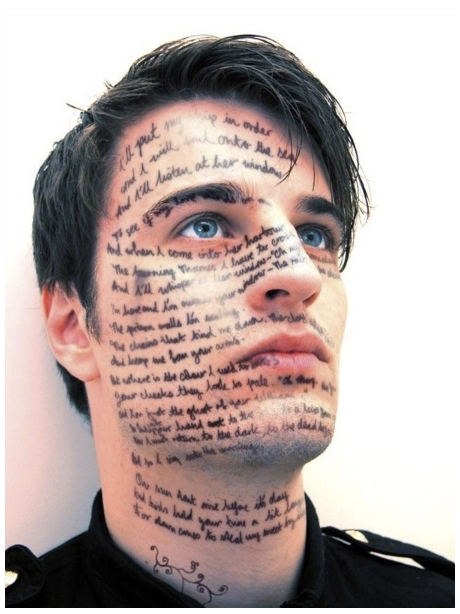 Since his debut in 2003, Jim Moray has been something of a poster-boy for exciting young English folk music, although Seth Lakeman runs him close. Seth is more trad, with his rustic good looks, while Jim has been praised to the skies for mixing traditional songs with modern rap, indie rock and so on. Nigel Williamson in Uncut called his debut album Sweet England ‘the most significant new development in English folk music since Fairport Convention’s Liege And Lief‘. That’s a claim that takes a lot of living up to… and I’m not entirely convinced.
The Suit is a big fan and persuaded us along to Jim’s album launch show at The Lexington. We’ll pass swiftly over the support band, Pig Earth, whose lead singer looked like a cross between John Lydon and Robert Plant. Suffice it to say, I will die happy if I never hear another Oirish version of Whiskey In The Jar again. Anyway, Jim came on with his band and gave a much rockier performance than when I’ve seen him before – lots of electric guitar, hurdy-gurdy and flailing fiddle.
I reckon most of the songs were from the new album, In Modern History, which is being offered for free on the cover of Songlines magazine on April 30th. This Prince-style move is brave, but it will ensure a wider audience – and fans can buy an ‘enhanced’ version in June. New song Hard sounds, well, hard, while folk favourites Long Lankin and Jenny Of The Moor were strongly done.
So what’s my beef with Jim? I’m not keen on folk piano, for one, not because I think the instrument’s ‘inauthentic’, but I do think he plays it in a very showbiz way – lots of swooning cresc. and dim., which, coupled with his emotive vocal style, almost tips his music into West End musical pastiche.
It’s interesting that his big 2008 album was called Low Culture. Despite it’s inclusion of rap and so forth, it shows very much Jim’s musical roots as a student of composition at the Birmingham Conservatoire. And you can’t get much more High Culture than that. I think Jim feels the tension, as he said of the album, ‘If folk song is the music of the people then it’s surely wrong to treat it as “high art” that should be preserved unchanged. Folk music is low culture.’ Absolutely right, but Jim’s work drips with a high musical appreciation, which to these ears often gets in the way of the tunes and the songs.
Astral says much the same about Bellowhead, whom we love listening to, but who are, I think, also something of a dead-end rather than a new way forward for folk – front-man Jon Boden’s second degree in Composition for Theatre from the London College of Music is fine and good, but it lends a style to the music that is somewhat stagey and, dare I say it, elitist. I’ve no fundamental problem with elitism per se, but I have when it comes to the low culture of folk. However, that’s not going to stop me enjoying Jim Moray’s rollicking version of XTC’s All You Pretty Girls:
Nancy Wallace, Jason Steel, The Straw Bear Band and The Owl Service, The Stag’s Head, Hoxton, April 25th 2010
 We hadn’t been to Come Down And Meet The Folks for quite a while – in fact, not since it moved from the Apple Tree in Mount Pleasant to the Stag’s Head in the wilds of Hoxton. It’s always been a laid-back way of spending a late Sunday afternoon, listening to music and drinking beer, with the hat passed round at some point.
Today’s headliners played at the last-ever In The Pines afternoon – another pleasant Sunday experience, now sadly gone – but first up was sometime Rockingbirds front-man Alan Tyler, who played a couple of his pleasant acoustic country rock ditties. The pints of Maldon Gold were going down smoothly as Nancy Wallace took the tiny stage accompanied by guitarist and singer Jason Steel. The two are label-mates on Rif Mountain and I raved last year about Nancy’s solo album Old Stories, which easily made my Top Ten of last year. We spotted folk guru and fRoots supremo Ian Anderson in the small crowd. I’ve recently got the fine compilation of his own music Time Is Ripe: Rare Psych Folk From The Village Thing Years 1970-73, which I thoroughly recommend. fRoots magazine is co-promoting Nancy and Jason’s gig at the Green Note next month, so I assume Mr Anderson thinks good things of them.
Sure enough, they delivered a very good set. I’ve seen Nancy quite a few times before and admire her pure voice, no-nonsense concertina- and guitar-playing, but I was also mightily impressed by Jason Steel‘s very fine guitar-playing and sympathetic vocals. They started with traditional saucy song Blow The Candles Out, aka The London Apprentice:
Your father and your mother in yonder room do lie
A-hugging one another, so why not you and I?
A-hugging one another, without a fear or doubt
So roll me in your arms, Love, and blow the candle out.
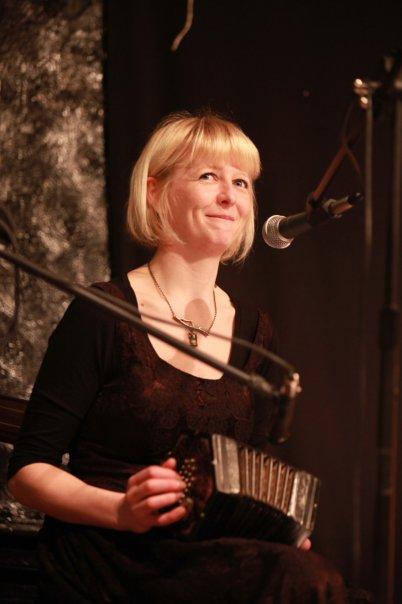 The pair then traded traditional songs, such as Leadbelly’s Goodnight Irene, and their own compositions, including Nancy’s Sleeping Sickness and an as-yet-untitled songs they’ve randomly called Vampire Scrapbook. The highlight, though, was a wonderfully performed Blackwaterside, the old song that Anne Briggs taught to Bert Jansch and which subsequently inspired many a guitarist, including Jimmy Page, who thieved it for Led Zep’s Black Mountain Side. Nancy’s singing was spot-on, while Jason showed some wonderful runs and flights of fancy. I’m very much looking forward to that Green Note show next month.
All the afternoon’s acts (barring Alan Tyler, Come Down’s… host) are on the Rif Mountain label and The Straw Bear Band impressed as well. Front-man Dom Cooper has a powerful voice, nicely balancing the delicate guitar and percussion behind him to create what they call ‘medieval Krautrock’ or ‘garage-folk’, which pretty much, er, nails it. Their set included trad songs, such as folk stalwart Nottamun Town, their own compositions and some surprising covers, including a spook-folk Bad Moon Rising. Good stuff.
Now I’d like to give you a review of the Owl Service’s set, but I can’t. Just before they came on, I spotted that DJ Wheelie Bag was standing near us, which meant that Pugnacious D, Astral and I engaged him in conversation during The Owl Service’s set. Oops.

DJ Wheelie Bag
Wheelie reminisced about his times at the Pillars, enthused about his latest musical love – ‘Cumbia’, a powerful mix of Colombian and African dance – and smiled as he recalled the various ways he has of getting the Rhythm Festival’s promoter to pay him. It would be lovely to spend a while longer chatting, but we needed to get to The Lexington for the Jim Moray show. More of which soon…
Swarb's 'obituary'
This evening’s gig at The Goose Is Out at Dulwich Hamlet FC was a Folk Against Fascism event for St George’s Day and I was sporting my FAF t-shirt. Go and get the FAF double CD – it’s excellent and only a tenner. Anything to piss off a fascist….
Swarb kicked off the first of two sets with a wedding march from Unst, the farthest of the Shetland Isles. He commented that he once stayed at a hotel on the island – the most northerly hotel in Britain – and it was crap. The Baltasound Hotel should be ashamed… Next was an old tune written for the Golden Cross pub near Lewes in Sussex, which was, according to folklore, a highwayman’s inn. It’s still there if you fancy a nice pint of Harvey’s.
We were then treated to a series of tunes including Carpenter’s Morris and Mrs Savage’s Whim, old triple hornpipes in 3/2 time – not easy to tap your toe to. One great aspect of a Swarb gig is his willingness to explain the tunes and give their histories. It’s probably the case that he knows more than anyone about many of these obscure tunes, but he acknowledges the importance of ‘the web’ in allowing access to many ancient tunes hitherto ‘lost’ in the bowels of the British Library.
He followed that with two melodies from old Northumbrian piper Billy Pigg, The Gipsy’s Lullaby and Carrick, and closed the set with a lively threesome, Buttock Beef, Rising Sun and Northern Frisk – the last is also known as The Merry Conclusion or Mr Kynaston’s Famous Dance, as recorded by fine duo Belshazzar’s Feast.
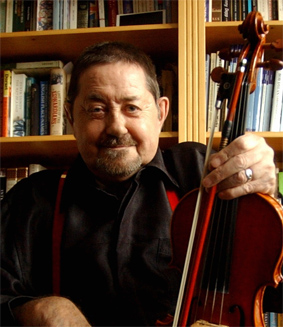 Astral, Mr P, the Queen of Herts and I then took the opportunity to recharge our glasses before Swarb’s second set, which started with a lively trio of tunes, The Long Jig, The Running Footman’s Jig and The Brown Joak, the last being a bawdy reference to the female genitalia. However, I’m not convinced by Swarb’s oft-told tale that this is the origin of our word ‘joke’. Surely both come from the Latin jocus or iocus, meaning ‘sport’ or ‘amusement’, but perhaps I’m being pedantic – popular etymologies often tell more about the world than true ones…
Swarb then digressed into the tale of the 18-year-old Edward Bunting transcribing harp songs in the 1790s, following it with three of those tunes handed down in Bunting’s The Ancient Music Of Ireland, including popular air Blind Mary. He then digressed further with an anecdote about a Donegal hotelier who proudly boasted that the ‘famous fiddler Hughie McMenneman’ had stayed there. Indeed, Yehudi Menuhin had… which brought us to the lovely Lament On The Death Of His Second Wife, by Niel Gow, which Menuhin had played in front of an appreciative crowd of Scottish folkies at the Usher Hall in Edinburgh back in the day.
After a couple of lively encores, Swarb was cheered off the stage, but he was still urging us to buy his CDs. Indeed, he has something of a reputation when it comes to the folding stuff, but to be fair he’s probably only ever earned tuppence-ha’penny. What’s more, although he’s also forthright with his opinions, he always takes time to remember and pay tribute to those who have gone before, including the previously mentioned Billy Pigg and Edward Bunting, along with those he’s worked with, including Diz Disley, who died last month, and Beryl Marriott, whose Birmingham ceilidh band gave him his first big break as a teenager. One day far into the future, when Swarb’s obituary, alas, won’t be a mistake, I’m sure many fiddlers and other folk musicians will similarly pay handsome tribute to Swarb for all that he’s brought to the world of music. Here he is from 2007 in Adelaide:
Every volcanic cloud has a silver lining, and the cancellation of Gil Scott-Heron’s Festival Hall show gave me the chance to see Robyn Hitchcock in Islington. I’ve seen him so much in recent times that we could almost be on speaking terms, but I realised it’s been a few years since I saw him do a full electric set of his own stuff – the other performances have been at the Incredible String Band tribute, an evening of sea shanties, the Syd Barrett tribute evening and so on.

Robyn with Mike Heron last year
I was also intrigued to see he’d invited ex-Incredible String Band man Mike Heron to support him on the tour. Mike performed at last year’s ISB bash at the Barbican and was OK, but not particularly inspiring (though nowhere near as disappointing as the sloppy ISB ‘final gig’ at Moseley Folk Festival four years ago). This time, I’m glad to say, it was a pleasure to hear him and his young band, which included daughter Georgia Seddon, a talented singer and performer in her own right.
Gentle old hippie song Painting Box showed that Mike’s voice has become older and richer – he is nearly 68 years old, so that’s no surprise – while he introduced The Hedgehog’s Song by saying that the Archbishop of Canterbury picked it as one of his Desert Island Discs. The song is whimsical without being grating, and contains some great lyrics:
Oh, you know all the words, and you sung all the notes,
But you never quite learned the song, she sang.
I can tell by the sadness in your eyes,
That you never quite learned the song…
Brilliant stuff and I urge you to check out the newly reissued and remastered first four ISB albums. As well as a couple of Georgia’s songs, we got a fine selection of ISB songs, including Chinese White, Everything’s Fine Right Now and a rollicking Log Cabin Home In The Sky, joined by Robyn Hitchcock (clutching a mug of what I assume was tea) on vocals. He stayed to join them for a lovely Air and an a cappella version of Sleepers, Awake! I was very pleasantly surprised and will try to see him again soon.
After a break, Robyn, dressed in a jazzy polka-dot shirt for those on Hitchcock fashion watch, came on with his band and launched into Wreck Of The Arthur Lee. It’s good to get the full electric band treatment, but it was nicely tempered by the sounds of Ruby Wright on saw (and later ukelele) and cellist Jenny Adejayan. Next was upbeat number Luckiness from Robyn’s latest album, Propellor Time (mostly recorded four years ago, in fact, with the Venus 3), followed by the entertaining Museum Of Sex from the contemporaneous Olé! Tarantula album. Oldies Oceanside and America rocked along groovily, while Kingdom Of Love entertainingly detailed two of Robyn’s great interests – love and insects:
In the spiritual kingdom of love,
You’ve been laying eggs under my skin,
Now they’re hatching out under my chin,
Now there’s tiny insects showing through,
And all them tiny insects look like you.

Antwoman: blimey...
More oldies follow, including Sounds Great When You’re Dead, with its marvellous opening couplet; ‘Your mother is a journalist / Your father is a creep’, and Antwoman, another sideways look at romance and exoskeletal life-forms, ‘Oh I dream of Antwoman / With her Audrey Hepburn feelers / And her black and white stripes.’
Apart from a discursive mention of that volcano and a little tribute to Arthur NY Doll Kane, we didn’t get much of that surreal Hitchcockian inter-song banter, which is OK. We don’t need that all the time and there were lots of juicy songs to get through, including Underwater Moonlight and set closer Statue With A Walkman. An enthusiastic (but decidedly ageing) crowd brought them back out for Raining Twilight Coast and Propellor Time‘s excellent Ordinary Millionaire. Finally, Mike Heron came on stage for a sing-along Olé! Tarantula and they wrapped up with Goodnight Oslo.
It had been a pleasure to spend the evening in the company of a singular talent like Robyn. He’s often labelled ‘eccentric’, which I suppose he is, but his surrealism and off-kilter humour sometimes conceal his sharp eye and fierce intelligence. If there were any justice in the musical world, he’d be a National Treasure. Catch him if you can.
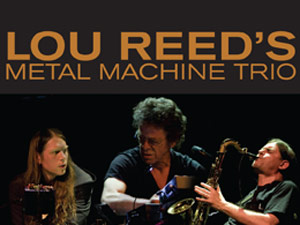 Hotfooting it from Wiltshire, we made it to the Cowley Road as a crowd stood outside the venue – a sure sign that the doors hadn’t opened yet, but I didn’t want to miss getting a good spot, so I joined them, musing on my memories of Lou Reed, Oxford and Metal Machine Music.
In my far-off student days of the early 80s, I tracked down an expensive import copy of MMM (the 1975 album had barely been released at all in this country) and eagerly told my fellow Lou buff, a dissolute young man who’s now the Professor of Film Studies at a respectable Midlands university. I see that he’s now regarded as an expert in ‘exploitation and horror’, which explains a lot.
Both of us loved all that mad, out-there New York art-scene stuff, so we decided that the correct way to appreciate MMM was to set up the speakers for that ‘binaural’ sound, drink a pot of mushroom tea, draw the curtains, turn off the lights and let Lou take over. I think I’d put a sign on my student-room door saying something like, ‘Do not enter – recital in progress’.
Our ears were then assaulted by a blizzard of feedback, looping in and out between low rumbles, high squeaks, blips and wailing crescendos. Four sides of it, at 16 minutes and 1 second a side. It was, well, quite an… experience, believe me. I later heard it all the way through ‘straight’ and the experience was surprisingly similar – despite some aural harshness, there’s a lot of white noise in there that clears the mind and allows the ear to start weaving patterns into the noise. After a while, it’s impossible to tell if you’re ‘hallucinating’ these patterns or if they’re ‘really’ there. I loved it, as did the Film Professor.
We urged others to listen to it, but they must have read some of the reviews – Rolling Stone described it as ‘the tubular groaning of a galactic refrigerator’ and ‘ear-wrecking electronic sludge, guaranteed to clear any room of humans in record time’. The great Lester Bangs was one of few to give it a sympathetic reception and wrote, ‘As classical music it adds nothing to a genre that may well be depleted. As rock ‘n’ roll it’s interesting garage electronic rock ‘n’ roll. As a statement it’s great, as a giant f*ck you it shows integrity – a sick, twisted, dunced-out, malevolent, perverted, psychopathic integrity, but integrity nevertheless.’
Time has perhaps been kinder to MMM. In 1995, Brian Eno noted, ‘Metal Machine Music was released the same week – twenty years ago – as Discreet Music… [which is] soft, calm, melodic and reassuringly repetitive, without a single sound other than tape hiss… whereas Metal Machine Music is as abrasive and unmelodic as possible, with almost nothing below – and yet they occupy two ends of what was at the time a pretty new axis – music as immersion, as sonic experience in which you float. The roots of Ambient.’ I think that’s true and I don’t understand people who call the album a ‘joke’, any more than Neil Young’s feedback-drenched Arc is a joke. You might not like it, you might even hate it, but it’s not a joke. Like Arc, MMM was an experiment by an artist who’s profoundly interested in sonic textures. And like many experiments, it might fail, it might be difficult (or even dull) to experience, but if you want to dig deeper, it’s quite possibly essential.
Lou’s Metal Machine Trio came into being when sax player Ulrich Krieger and computer-keyboard wiz Sarth Calhoun contacted him about permission to play music inspired by MMM and he liked the idea so much that he asked to join them. Before the gig proper, the three of them trooped on stage and fiddled with the set-up – five amps of various sizes, makes and vintages, along with two guitars, propped up on two of the amps, strings facing inward. They then successfully engineered setting up a low fuzzy feedback but without playing either of the guitars, at which point they trooped off again for twenty minutes, leaving an empty humming stage.
Now comes one of my audience rants. The people behind me (young, dumb and loud) saw this as background music to their painfully inane conversation. Eventually I glared at them and they toned it down, but I don’t think they quite understood. This sound was there to be listened to, but I seriously wonder how many people are capable of just listening. It’s not difficult, though it can take some concentration, but that’s not asking for the world, is it? Sheesh – mind you, before the show, one of their number asked the others what songs they thought Lou was going to play. As I say, dumb.
When the trio came on again, the sax immediately started a wailing feedback as the amps were miked up to it. Simply by waving it in the direction of his monitor and/or the amps. Krieger managed to get some fabulous noises out it. Eventually they did start to play their instruments – sax, guitar and computer/drum machine – but only with large doses of feedback looping between instruments and, on occasion, with just one of them playing with the background hum continuing.
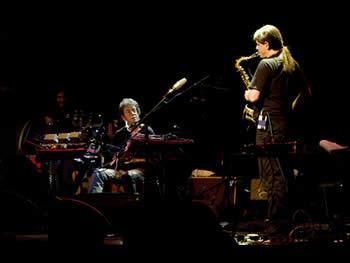 This carried on for something just under an hour and a half, which, strange as it may seem, flew by. Several times, I was aware of building sonic structures and patterns in my own mind. It’s almost as if the music were a mantra. When the hum got louder and louder, it oddly became less distracting and reminded me of a ‘calming’ white-noise cassette tape we used to play to son Humungous when he was a little baby and wouldn’t sleep. Here’s a modern equivalent – a free downloadable hairdryer-noise mp3.
We often overlook odd everyday noises and discount their claim to be ‘music’, which I think is similar to the negative reaction to listening to MMM. Just this morning I read the following comment from 1937 by John Cage which was quoted in George Berger’s very readable The Story Of Crass:
Wherever we are, what we hear is mostly noise. When we ignore it, it disturbs us. When we listen to it, we find it fascinating.
I think Lou would approve.

 A Gig's A Gig