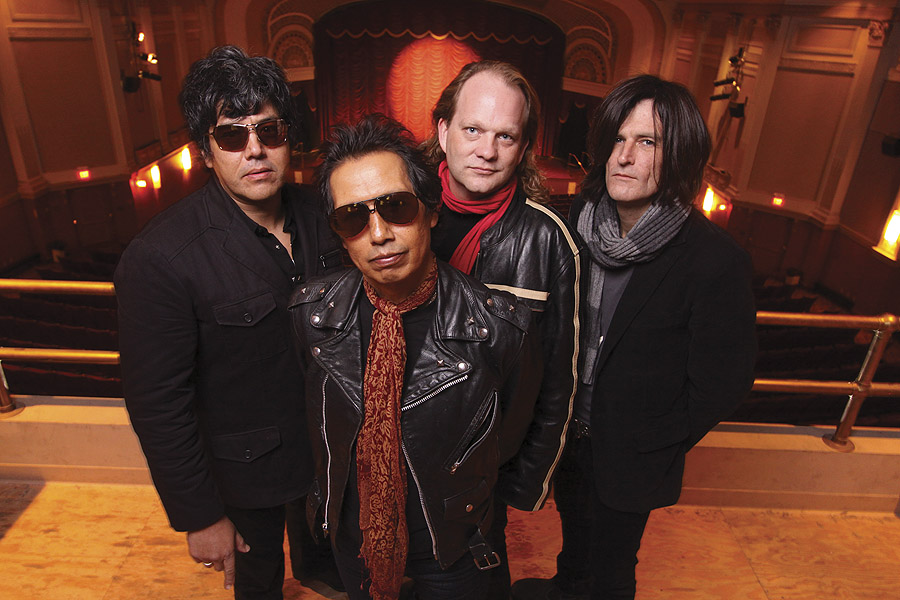
 One significant gap in my Americana-rock-alt-blah-blah gig-going has been Alejandro Escovedo. I’m convinced his agent waits until I’m on holiday or elsewhere before booking Al into a London venue. Paranoia aside, I like Alejandro’s music and possibly even more so in recent years – to my ears, there’s a solid and unique strain of punk-acoustic-Mex-country-rock thing going on that he’s almost perfected. His good buddy Chuck Prophet has taken a similar route, although Chuck’s influences and styles are somewhat broader overall.
For the uninitiated, Al was raised in California by Mexican immigrant parents in what is clearly a musical family, including cousin Sheila E. Al was first attracted to hard rock but joined punk band The Nuns, whose claim to fame was that they supported the Sex Pistols at their last ever gig at the Winterland in San Francisco.
Parky and I took up a nice spot near the front in the sold-out Borderline as Al and the Sensitive Boys took the stage for a rip-roaring Always A Friend, the song he co-wrote with Chuck and which was picked up by The Boss in his live shows. This was the first of five songs tonight from 2008’s Real Animal album that he co-wrote and performed with Chuck, and all the tunes pack a punch.
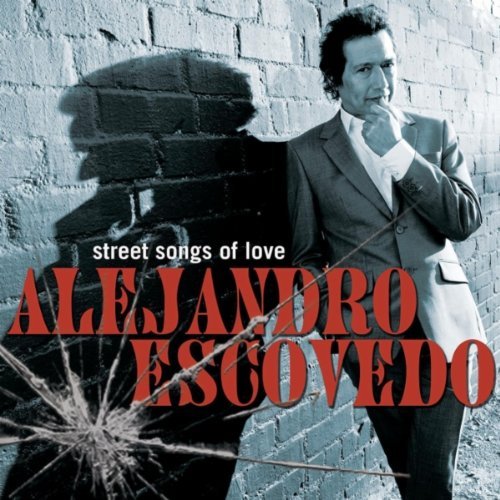 All this talk of punk, punch and rock might be misleading, as there’s a quieter side to Al’s music that’s never overshadowed by the loud and heavy stuff. He’s a fine songwriter and it was good to hear a bunch of songs from his new album Street Songs Of Love, including a nice threesome straight after the show’s opener – This Bed Is Getting Crowded, Anchor (the current single) and Tender Heart. Even when they’re playing acoustics, Al and talented sideman David Pulkingham trade blistering guitar between each other, even on the ‘love songs’.
Al dedicated the album to his first record producer, Stephen Bruton, the Austin music wizard who sadly died last year. His last two albums have been produced by the legendary Tony Visconti, which is appropriate given Al’s abiding love of 70s music, and sure enough we were treated to some fine covers tonight, including All The Young Dudes (Ian Hunter guests on the new album) and a massive I Wanna Be Your Dog.
There were only a handful of Al’s songs that weren’t from the last two albums, including Everybody Loves Me, from 1999’s Bourbonitis Blues, and Castanets, the song that George W Bush had on his iPod. Al said he ‘wasn’t proud of that’ and indeed for a while he stopped playing this standard, but relented after a couple of years, especially now that Dubya has thankfully become an ex-President.
It was a great evening of heavier and lighter rock, played with passion, fun and a huge dollop of real talent. I just hope I don’t have to wait a lifetime to see him again. Here are Al and David performing the new single for Rolling Stone:
 Sunday morning coming down… in our case, down to another hearty Premier Inn breakfast, much to the lads’ delight. The weather had perked up, so we fancied spending much of the day lounging around on the festival lawns and doing nothing much. The day’s music was set to finish at six o’clock, so it was a truncated day, but a lovely sunny, warm one. The morning was punctuated by the sound of stick and bell as the Morris men were in full swing. We stayed near the bar, which was the right thing to do, though some of the younger Morris lads congregated there in the hope of attracting girls – in the world of folk, I guess a Morris outfit constitutes a uniform and you know how a girl just can’t resist…
 We sauntered into the big tent for a lively and fun set from Kerfuffle (left), the young folk band fronted by Bellowhead fellow Sam Sweeney and Hannah James, supported by Sam’s brother Tom on bass. Sam explained that this was their last tour as Tom was leaving to get a ‘proper job’, but they’d carry on in some incarnation. We got clog dancing, fine fiddle-playing and some very good accordion, which was a nice way to blow away any Sunday cobwebs.
Next on the EFDSS-sponsored stage were Will Pound and Dan Walsh, two young and hugely talented exponents of the harmonica and banjo respectively. They look like they’re barely out of school, but they’ve both graduated from Newcastle University, having studied Folk and Traditional Music for their degree. Thankfully there’s nothing stagey about their performance – in fact, from time to time it’s endearingly casual – but there’s no denying their immense talent and their great ability to meld two apparently disparate instruments into a vibrant whole. There were plenty of traditional folk and bluegrass numbers in their set, but also a cover of Paul Thorn’s Hammer And Nail, a bit of Horslips and a splendid Turkish-Balkan style improvisation. Pound and Walsh make a very good team and will, I hope, go far.
There was then plenty of time for more lolling and soaking up the sun, as the strains of a band called Woodstock drifted from the far end of the beer tent. As their name might suggest, they play a whole lot of CSNY, Joni Mitchell and Neil Young covers, including Out On The Weekend, which sounded pleasant enough, but not sufficiently powerful to drag me in from my sunny spot. Eventually we went back into the big tent to see talented fiddler and singer Jackie Oates. She played an entertaining set of jigs and reels and old folk songs, including Alasdair Roberts’ take on The Lover’s Ghost, otherwise known as Ghost Lover or, in a slightly different form, The Grey Cock. It’s the usual spine-chilling tale of a young chap who, after many years away, visits his love at the dead of night and proves to be, well, dead:
Oh, when shall I see you my love? she cried
Oh, when shall I see you again?
When little fishes fly and the seas they do run dry
And the hard rocks do melt with the sun.
Alasdair Roberts also wrote the title track of her fine album Hyperboreans and, with Jim Moray as both brother and producer, she’s in the company of a lot of young folk talent but is more than capable of matching the best of them.
And so to the finale, a rousing set from the Oysterband to send everyone home happy. I enjoyed this more than I did last year and I think there’s something in the air that prevents too much political grandstanding – frontman John Jones suggested that they are ‘… the perfect band for a recession. Miserable lyrics set to happy tunes.’ And the big audience singalong number is Everywhere I Go which I prefer to many of their political songs as it doesn’t paint the world in black and white:
And war is peace and peace is war and less is more and yes is no,
They want to tell you this, they want to tell you that,
Just hold your hat when the black wind blows.
Everywhere I go I hear what’s going on
And the more I hear, the less I know.
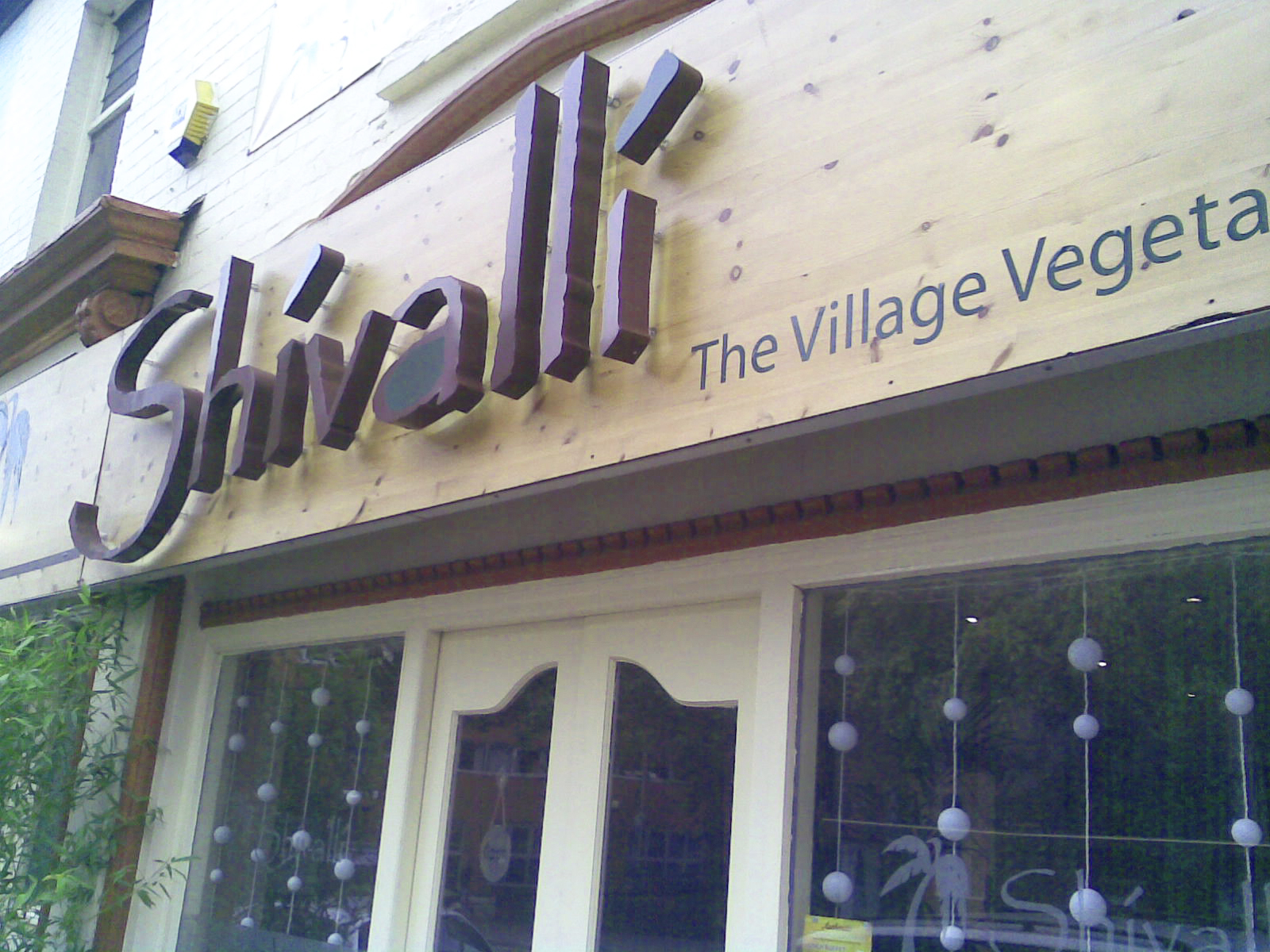 After we’d left the festival, we tried out the vegetarian Indian restaurant Shivalli down near the railway station. The good news is it’s fantastic – we gorged ourselves on a fabulous veggie buffet – and we’ll be back in August when we come up for the Summer Sundae Festival.
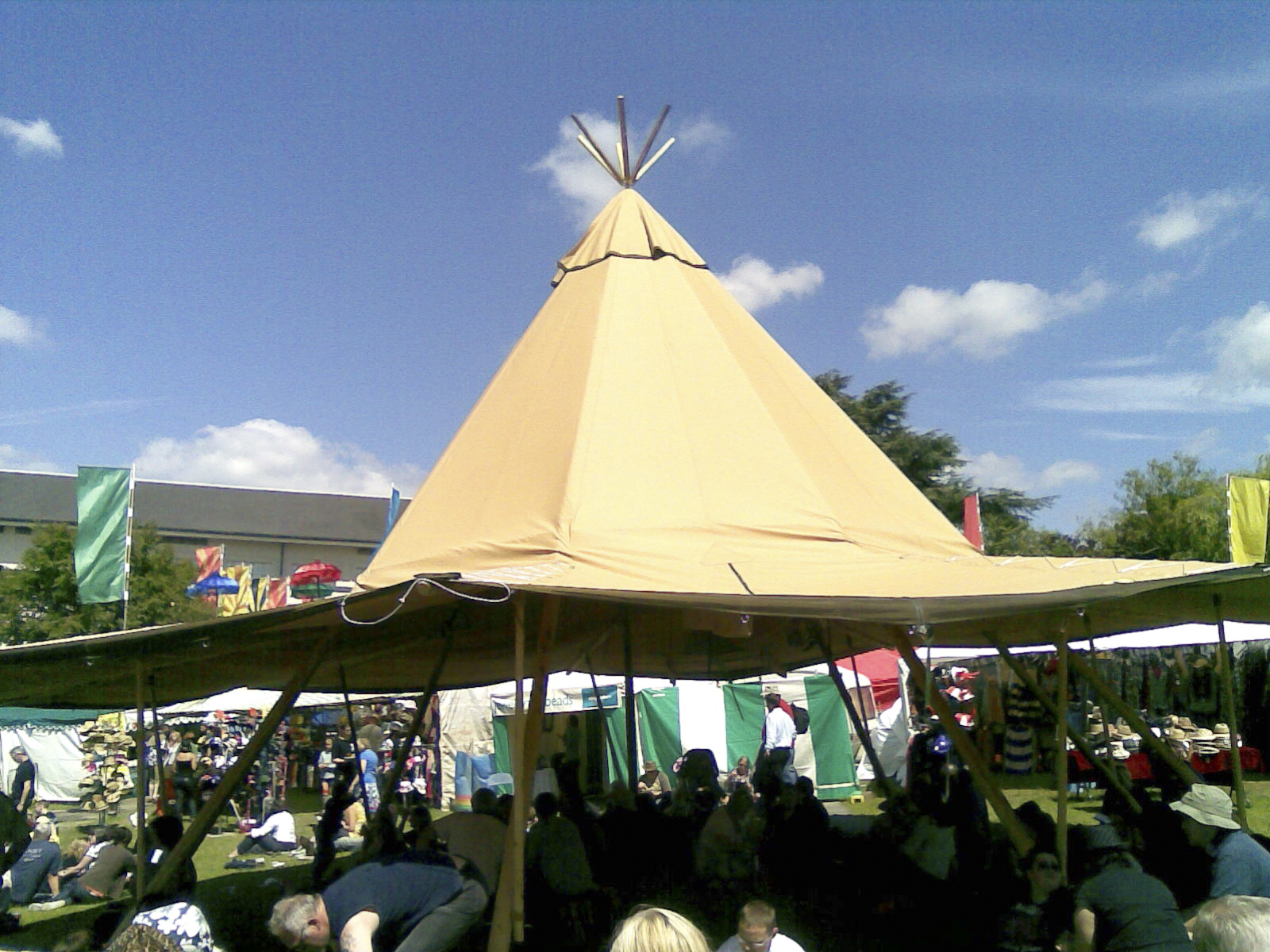 After a mighty all-you-can-eat buffet breakfast at the Premier Inn, we walked back up to De Montfort Hall for a full day’s Big Sessioning. The weather was still a bit nippy, so we popped into the big tent to see folk wunderkind Blair Dunlop, the 18-year-old son of folk ‘Guv’nor’ Ashley Hutchings and singer Judy Dunlop. He started with an instrumental and some impressive guitar skills, and showed a wide variety of folk influences in the rest of his set, which included standard Black Is The Colour, a medley of Morris tunes, a Damien Rice song and a fine version of Nic Jones’ Canadee-i-o. Understandably at his age, he can be a little hesitant on stage and his voice needs to develop some more, but I was impressed. As Astral pointed out, though, if he’s going to make a name for himself, he’ll probably need to fly the folk nest and seek inspiration and collaborations elsewhere. One to watch…
We nipped into the big hall to see upcoming folk youngsters Tyde, with a trio of fiddle, guitar and accordion. They were lively and jolly, but as nearly all of their set comprises jigs and other dance tunes, it becomes difficult just to listen to it. A few more songs and a change of pace would sort that out – and the accordionist is very good indeed. Next on the big stage was Nancy Elizabeth (below left), who’d impressed us at the Barbican the other month, and we weren’t disappointed this time.  Her songs are finely wrought and well-performed, she’s a congenial host(ess) and she was accompanied on some tunes by bassist Jon Thorne, who seems to get everywhere these days – not that I’m complaining. She also did a lovely cover version of Lal Waterson’s Cornfield, which was also her contribution to the fine Lal Waterson tribute CD Migrating Bird.
The weather hadn’t picked up much, but I went out for more beer before hitting the big tent for the Holy Bandits, who are really an acoustic Oysterband with a couple of guest vocalists. They were fun and bouncy, and this style is perhaps more to my taste than their electric stuff, which can veer towards the ponderous on occasion.
In my experience, some festival-goers are ‘box tickers’ and rush around at the mercy of the clock, while others just wander around taking in whatever’s on offer. I suppose I’m somewhere between the two in that I’ll go through a festival line-up meticulously highlighting the acts I want to see, but when I get there, the plan goes halfway out of the window. So late Saturday afternoon became something of a ‘do nothing’ time, which meant accompanying Astral to the real ale tent for further tasting opportunities. What I didn’t expect was one of the highlights of the whole weekend – Warblefly, who were playing in the beer tent.
They’d been bigged up in the festival programme as the Pogues on drugs, which really isn’t necessarily a good thing, but their roaring set of drinking, fighting and shagging songs was a real tonic. The lead singer played the part well, despite looking like a rather dandified English version of David Johansen, while the bass player was the spit of Roger Waters circa 1990. Spooky. Their playing was great fun – lots of fiddle, accordion, bass and loud choruses – and they eventually persuaded most occupants of the tent to get up and dance. Beer tents were made for music like this.
 I was beginning to feel peckish, so I went along to venerable festival institution Leon Lewis and his veggie delights (left). Leon’s been doing festival food for thirty years and it’s just the sort of wholesome veggie fare to keep you going. It’s also delicious and, what’s more, he’s not even paying me to write this… A huge plate of Mediterranean veggie delights hit the spot and, after a couple more beers, it was time to ignore the main headliner indoors, Kate Rusby, and head for the big tent to see Dreadzone.
After a few technical glitches – even reggae acts use MacBook Pros these days it seems – the band took to the stage and delivered an entertaining set. There was a tiny bit of folk and a smattering of hip-hop and electro, but essentially they’re a good old-fashioned dubby reggae band with a radical edge. Just the way to finish off a Saturday night. Right, one more pint and then bed…
 We’ve been going to The Big Session Festival as a family for a few years now. It’s usually our first festival of the ‘season’ and it’s a gentle re-introduction to the world of damp feet and dodgy bogs, as it’s held in the grounds (and hall) of De Montfort Hall in Leicester. Not only does that mean decent facilities, but it also means we wimp out of camping and stay at the Premier Inn or the Travelodge in the city centre, a mere 15 minutes away on foot.
The Big Session is hosted by the Oysterband, one of England’s best-loved folk-rock bands, whose loyal followers treat this as their highlight of the year. The band finish off the weekend on Sunday night, but usually crop up in various combinations through the weekend too. I’m not their biggest fan – sometimes the clenched-fist radical stuff is a bit too anthemic and simplistic for my tastes – but they do put together a great festival comprising the rockier end of folk.
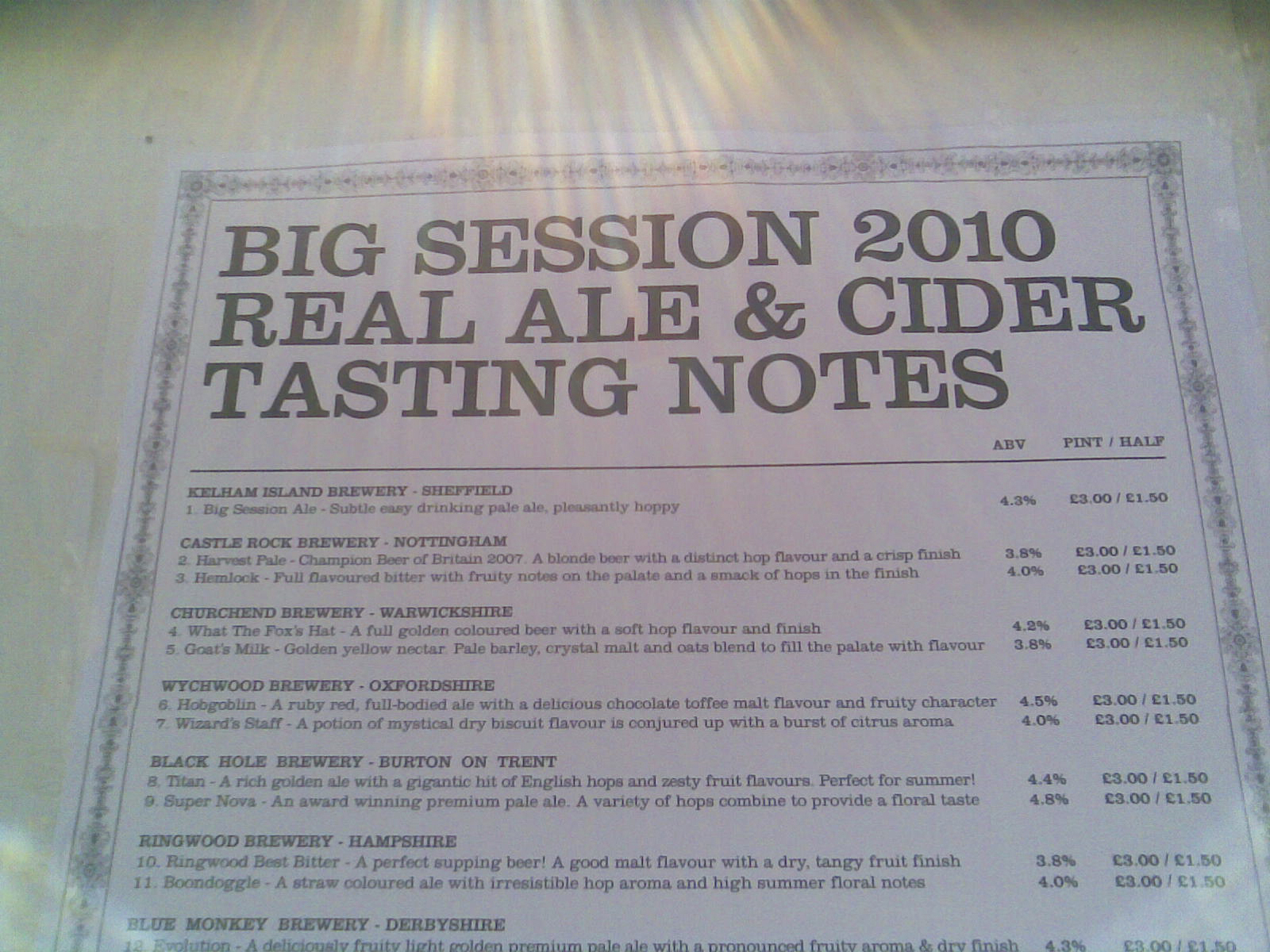 After checking into the hotel, we wandered up to De Montfort Hall, got ourselves wristbanded and headed for the real ale tent. We said ‘hi’ to Jeremy from AmericanaUK and ordered our first pint of the weekend. The selection of beers was excellent and we kicked off with a classic, Castle Rock’s award-winning Harvest Pale from nearby Nottingham. There are three stages at Big Session – the big indoor hall, the big-top tent and the smaller stage in the real ale tent. We went into the hall for our first taste of the weekend’s music, Julian Gaskell and the Ragged Trousered Philanthropists, a splendid name for a band specialising in a sort of Balkan-klezmer-tinged silliness with a radical Cornish twist. Julian himself is quite an engaging ranter and a very good accordionist. There’s something punky and attractively Beefheartian about the band, but much of the drollery is a bit too rich for my tastes.
Back in the big-top tent, we saw the Oysterband’s venerable bass-player and cellist Ray ‘Chopper’ Cooper front his own folk-rock band, which was definitely toe-tapping but sometimes too declamatory. The driving rhythms and stirring choruses can begin to overwhelm, though ‘Chopper’ is a genial host and fine musician. After another trip to the beer tent, it was back to the tent to see John Smith – for the third time this year. Happily, this was a much better experience than when we last saw him play with a band. Despite his latest album straying away from folk to some thing more mainstream, this was a much looser and interesting set than I perhaps expected. He has the excellent Jon Thorne on upright bass and the music felt earthier and more personal than last time we heard them. Just a correction though, John – the song The Time Has Come was written by Anne Briggs, not Sandy Denny, despite the fact that Sandy was the first to record it. A simple and simply great song:
Oh, my babe, don’t you know,
The time has come for me to go.
Tomorrow comes like yesterday,
The autumn fades our love away.
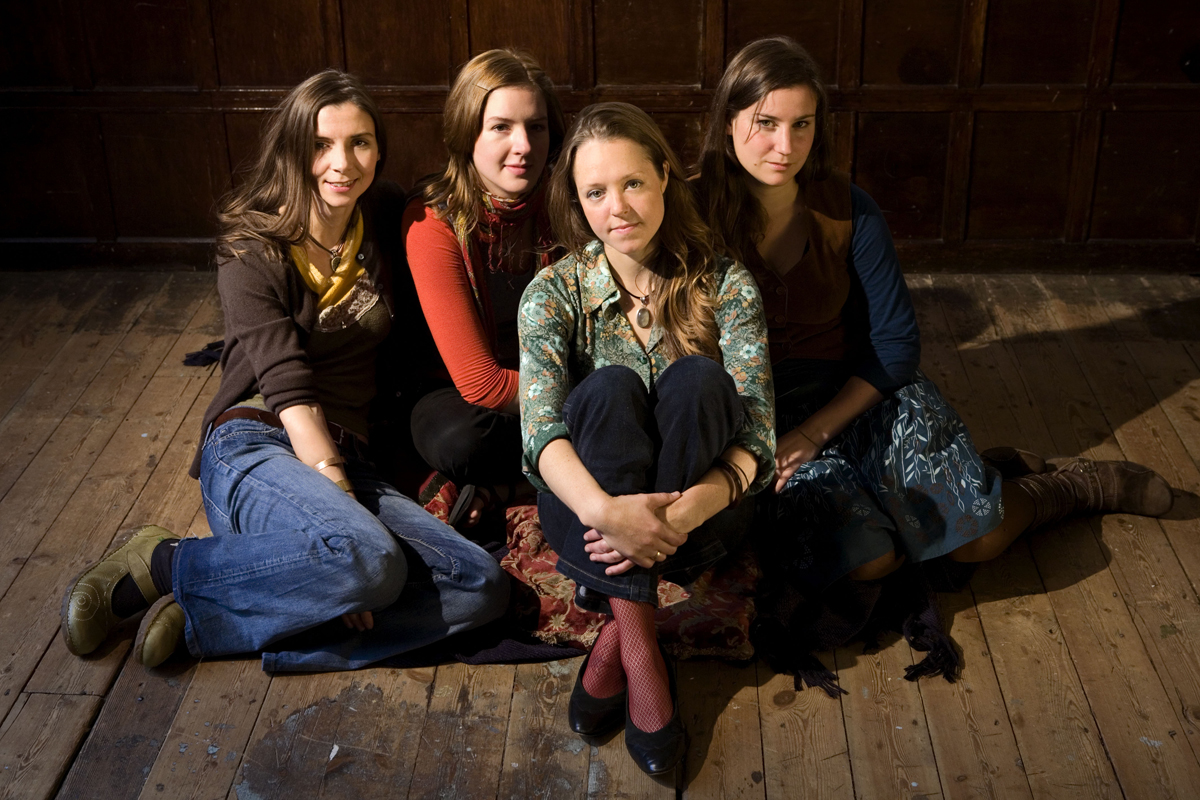 And talking of fading away, we then had the dubious pleasure of watching England’s tedious and alarmingly poor 0-0 draw against Algeria in the Word Cup finals, but immediately after the game I was cheered up by Emily Barker and the Red Clay Halo (left), who were playing in the beer tent. Aussie Emily has lived on these shores for a number of years and plays a very engaging country-folk style. Opening number Little Deaths was followed by a Neil Young cover, Look Out For My Love, then Blackbird and Ropes from their upcoming album, which is currently being ‘fan-funded’ at the excellent Pledge Music website. It’s a fine idea and one that many small bands could surely benefit from. Emily and the band finished with Nostalgia, which has become popular as the theme song to the BBC TV series Wallander and one little lad at the front started dancing energetically, which was sweet.
I missed the chance to see headliners The Proclaimers in order to witness The Rockingbirds in the big tent. Alan Tyler and the boys put on a great Friday night show of Gram-inspired Byrdsian country rock. We’d seen them re-form for the Edwyn Collins Heavenly gig the other year, and they were fab. After a rocking Love Has Gone And Made A Mess Of Me, we got lots of cracking oldies, including Further Down The Line, the Richman-inspired Jonathan, Jonathan and the John Hartford song Tall Buildings. It was a pleasure to see and hear them again.
We nipped inside to see the last two minutes of The Proclaimers in the big hall, then had one last pint and headed back to the hotel. Roll on Saturday…
Roy Harper, The Jazz Café, London, June 5th 2010
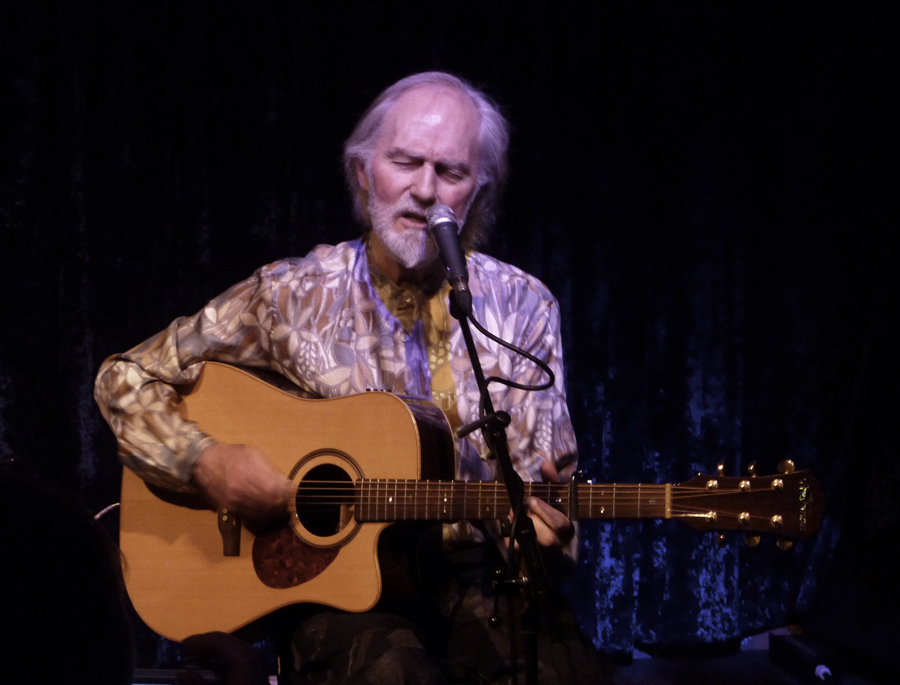 This gig, courtesy of Mojo magazine, was one I thought might never happen. Over the last three years, Roy Harper – England’s finest radical acoustic singer-songwriter – has suggested that he’s had enough of live performance. At the age of 69, the chaotic fun of a Roy gig might just be getting too much for him. The last time I saw him, at the 100 Club, he physically evicted a crazy ex-girlfriend for shouting and screaming at him, a crowd of very drunk Glaswegians shouted and sang raucously all night, and one young chap climbed on the stage and asked to join Roy in a rendition of his early tune Blackpool. At the time, it was all quite surreal and enjoyable, but I left thinking that Roy might not want all that crap at his time of life – not that he’s noticeably mellowed, but maybe we should show him a certain amount of the respect that is due to the older and wiser among us.
I’d love to ramble on at length why I think Roy deserves the accolade I gave him above, but time is tight and I’m falling behind with this blog as it is… so I’ll just give you a bit more background with these comments I made on Facebook a while ago about the first time I saw Roy, at Birmingham University way back in 1978:
OK, this is where it starts getting weird. I’d discovered Roy thanks to Led Zeppelin’s Hats Off To Harper and I was hooked… I’d got hold of his Lifemask album and loved its attitude and aggression… this wasn’t some winsome folky in a field smiling at buttercups, this was a headcase who wanted to air his grievances. Fantastic.
Anyway, so a friend and I get to the gig to discover everyone sitting on the floor. Whaaa…? Why are they doing that? We’d never been to a ‘laidback’ gig before – and I mean laidback. The entire audience was outrageously stoned and Roy himself had clearly smoked an entire bush – which for him is just about right. And as with most Roy gigs, you get five minutes of song followed by ten minutes of anecdote. You soon get used to it…
Last year, Roy said that he’s had enough of playing live, which is the world’s loss. Genius.
Thankfully, he crept out of semi-retirement this year to play a few gigs supporting Joanna Newsom (not my thing – and it’s not for Roy to support anyone in my not-so-humble opinion) and this one solo gig at the Jazz Café. The Suit, Mick the Banjo and I joined up with Hippy Nick at the Spread Eagle for a few ales before the show, but we arrived in good time to take a spot close to the stage – unlike Jimmy Page, who’d planted himself at a table on the small balcony.
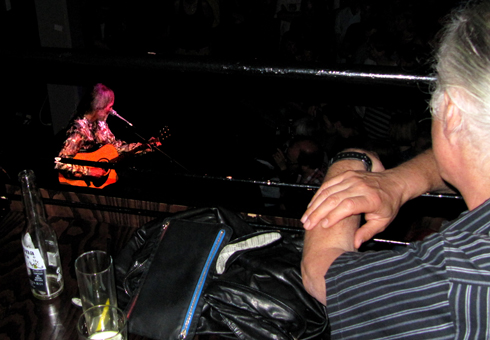
Jimmy Page 'rattling his jewellery'...
It’s a great song to kick off with, dealing as it does with two of Roy’s great enemies – the Army and the Church, two of the three pillars (along with Government) that he sees as utterly destructive of the human spirit and the ‘old ways’. In that, he shares a certain similarity with other post-War English musicians who kicked against the Establishment and the people’s acquiescence in its hegemony – I’m thinking here particularly of John Lennon and Roger Waters, both of them (like Roy) war babies.
You tell me that Granddad was a hero,
That he fought for peace and no more guns,
But you know I think he must have changed his name to Nero,
You see every time he grunts he kills his sons.
That’s an extreme thing for a post-War Englishman to say, but, like most of Roy’s songs, it rings loud with truth, whether you agree with it or not.
If you have the time, it’s worth reading some of Roy’s extensive notes about this and other songs from the Stormcock album on his blog. About One Man‘s everyman character, Johnny Soldier, he says: ‘[He] represents somewhat willing but increasingly unimpressed gun fodder. He is much more self-determined than would have been possible for his equivalent even fifty years previously. He’s found himself and he has a voice and an attitude. The attitude is more articulate than the voice.’ That’s a pretty good description of Roy himself – the voice can sometimes be slightly too strident or bathetic, but the attitude is always, always spot-on. And Roy’s blog is also entertaining for such conversation-stoppers as, ‘The horrible death of the progressive Giordano Bruno in 1600 will tell you all you need to know about the policies of the church/state.’ Follow that.
In fact, Roy followed it with a very sweet version of The Girl From The North Country, showing the other, more sensual, side of his music and his obsessions. After the stirring Judas anthem Don’t You Grieve and 1988’s Pinches Of Salt, he treated us to a devastating rendition of Hangman, his nakedly painful and desperate plea against capital punishment. But, as ever, Roy doesn’t see things in black and white – the grey in between can turn black too: ‘We are creatures of darkness’ indeed.
Following Another Day, a pretty song popularised by Kate Bush and Peter Gabriel, Roy sang Commune, which is now a period piece (in a good way) and a beautiful one at that. There was a fair amount of banter going on all evening and at one point mention was made of the screaming woman mentioned above, and Roy wondered whether she was still with us… Not at this gig, thankfully.
After pagan paean The Green Man and the sensual Me And My Woman, Roy said goodnight. The crowd applauded wildly and got to vote on the encore – only one, alas, because there was a club night following the show, so a strict curfew was in place. When An Old Cricketer Leaves The Crease won the vote and it was a beautiful and emotional way to close the evening. I left wondering whether Roy had perhaps left the crease and we might not see him again.
When the day is done, and the ball has spun, in the umpire’s pocket away
And all remains, in the groundsman’s pains for the rest of time and a day,
There’ll be one mad dog and his master, pushing for four with the spin,
On a dusty pitch, with two pounds six of willow wood in the sun.
When an old cricketer leaves the crease, you never know whether he’s gone,
If sometimes you’re catching a fleeting glimpse of a twelfth man at silly mid-on,
And it could be Geoff, and it could be John, with a new ball sting in his tail,
And it could be me, and it could be thee, and it could be the sting in the ale,
Sting in the ale…
Here’s One Man Rock And Roll Band from the gig:
Pixies, Troxy, London, June 3rd 2010
 It had been along time since I saw the Pixies – Brixton Academy in 1991 and the alcohol-free (thanks to a licensing cock-up) Crystal Palace Bowl show that same summer. They split up acrimoniously a couple of years later and reformed in 2004, though I hadn’t managed to get tickets to see them since then. So I was pleased to get a ‘fan club only’ email from them inviting me to buy tickets to an ‘intimate’ show at London’s Troxy and suggest songs for the setlist, which I thought was fun. I diligently sent in my choices, most of which they played, which was nice.
The Pixies only released a measly five records, of which my favourites are undoubtedly the second and third, Surfer Rosa and Doolittle. I was interested to hear how many songs from each album were going to be requested. In case you’re interested too, here’s the breakdown – you might need to know that on Cambridge University’s Austism-Spectrum Quotient Test, I scored enough points to get me heavily medicated in some countries…
Come On Pilgrim – 4 songs
Surfer Rosa – 7 songs
Doolittle – 7 songs
Bossanova – 6 songs
Trompe Le Monde – 5 songs
That’s pretty much how I’d wanted it broken down, perhaps with even more songs from Surfer Rosa and Doolittle, but who’s complaining?
The band came on shortly after Cinnamon Girl came over on the PA, which put me in a good mood, and crashed straight into instrumental opener Cecilia Ann followed by Rock Music, both from Bossanova, an album I like but don’t love because of its too lush production. After Bone Machine from Surfer Rosa, we were treated to a wonderful triple from Doolittle – Monkey Gone To Heaven, Gouge Away and Hey. This was really good stuff and the band seemed to be enjoying it too. The sound was fine – at the Brixton Academy all those years ago it was dreadful as I recall – and they played very tightly, which is not surprising after all these years, as there’s not exactly a large back catalogue to choose from.
Next up was a triple from Bossanova – Velouria, Dig For Fire and Allison – which show the strengths and weaknesses of that album, namely great riffs, fun lyrics, but not spiky enough for my ears. The point about Doolittle is that there’s an unfocused sense of menace about the songs in a punky way, which lifted the Pixies as a band above most of their contemporaries and is the reason why they were so loved by Kurt Cobain, amongst others.
Francis was playing and singing his heart out and, dare I say it, seems to have lost some weight, while Kim Deal, bless her, appeared to be delighted just to be there. She grinned away as she kept on and on between songs about how cool it was that we’d emailed in our requests, about how email is great and that we should carry on emailing each other. Very sweet.
We were at one of the front table seats on the balcony, which made it feel rather like some sort of 50s supper club, but down below, despite the audience’s advancing years, there was some serious moshing going on. The place was packed and began to get uncomfortably hot too. 2,000 humans create quite a lot of heat – I suppose if I was seriously A-Spectrum I’d tell you precisely how many kilojoules that is, but I won’t, so there’s hope for me yet. I’d really enjoyed the evening as a mosh down Memory Lane and the band played well and with lots of energy. I’m not sure I’d really want to see them again, though. Unless they produce a load of new and interesting songs, the shows are going to carry on being greatest hits shows, which is great once or twice, but ultimately unsatisfying.
The Memory Band, The Luminaire, London, June 2nd 2010
We’d enjoyed the Memory Band gig back in March and I remember mentioning then that I’d been sorry not to have caught their Wicker Man show, during which they play most of the songs from the film. They’d played the sensuous Wicker Man song Gently Johnny at that show and my appetite was whetted, so I was pleased to see that they were doing the pagan thing at The Luminaire tonight.
I arrived just before they came on and settled myself down with a Sierra Nevada, ready to enjoy the soundtrack coming alive. The opening title song of the film is a slightly altered and anglicised version of The Highland Widow’s Lament, a ballad written by Robert Burns:
O, I am come to the low country,
Och on, och on, och rie!
Without a penny in my purse
To buy a meal for me.
One time I had a hundred sheep,
Och on, och on, och rie!
Skippin’ on yon narrow creek
And growin’ wool for me.
The Memory Band from Hungry Hill on Vimeo.
As the video shows, they performed the show in a line, which was very effective and gave an intimate feel to the songs, which are, after all, quite ‘organic’ in the manner of the film itself. The ballad is a sombre scene-setter for the film in that it prefaces the main action by giving some background – the Highland clearances and the apparent loss of the ‘old ways’. I’d love to ramble on at length here about the film and its meanings, but I fear I’d never stop, so on with the music…
The band assembled for this evening comprised ringleader Stephen Cracknell on guitar and vocals, Sam Carter on guitar and vocals, Rob Spriggs and Dan Mayfield on viola and violin respectively, Hannah Caughlin and Helene Bradley on vocals and Sarah Scutt on accordion and recorder. They did a fine rendition of Corn Rigs, one of the better-known songs from the soundtrack and, like the first one, based on a ballad by Robert Burns, but this time of a more earthy and sensual variety, in keeping with most of the rest of the soundtrack songs:
The sky was blue, the wind was still,
The moon was shining clearly,
I set her down with right goodwill
Among the rigs o’ barley.
Most of the songs in The Wicker Man were written or adapted from traditional songs by American Paul Giovanni, which gives them a strange aura that’s almost traditional folk, but also quite stagey – none more so than the rollicking pub singing of The Landlord’s Daughter, which the band perform lustily. The four singers succeeded in giving the vocals some ‘oomph’, while the accordion and fiddles kept things rolling along. Gently Johnny is the flipside of the previous number, an intimate and sensuous song and a plea for young men not to rush things, so to speak…
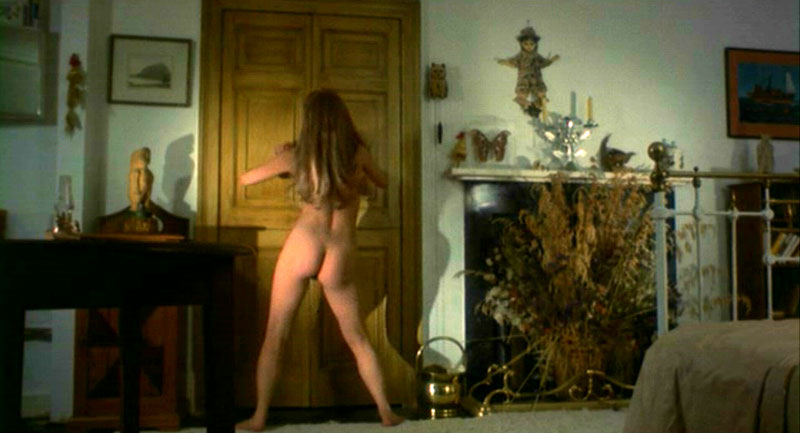
Britt Ekland – or, more likely, her 'bum double'
Many of the rest of the songs are similarly overtly sexual, but their tone is often quite restrained and sedate, from Fire Leap to the often covered Willow’s Song, as lip-synched by Britt Ekland. In fact, Britt didn’t just not sing the song, it also wasn’t her derriere in the film – she had a ‘bum double’. One highlight of the show was a well-executed rendition of The Maypole Song, with its appropriate ’round’ sound and structure:
In the woods there grew a tree
And a fine, fine tree was he
And on that tree there was a limb
And on that limb there was a branch
And on that branch there was a nest
And in that nest there was an egg
And in that egg there was a bird
And from that bird a feather came
And of that feather was a bed
And on that bed there was a girl
And on that girl there was a man
And from that man there was a seed
And from that seed there was a boy
And from that boy there was a man
And for that man there was a grave
And from that grave there grew a tree…
The old traditional song Summer Is Icumen In finishes off the film as the wicker man burns, but most of the rest of the music is weirdly unrooted in tradition, which gives it a magical and unworldly feel and which The Memory Band capture very well. I was just disappointed that there wasn’t a giant Spinal Tap-style conflagration on stage to complete the evening. Still, that’s ‘elf ‘n’ safety for you…
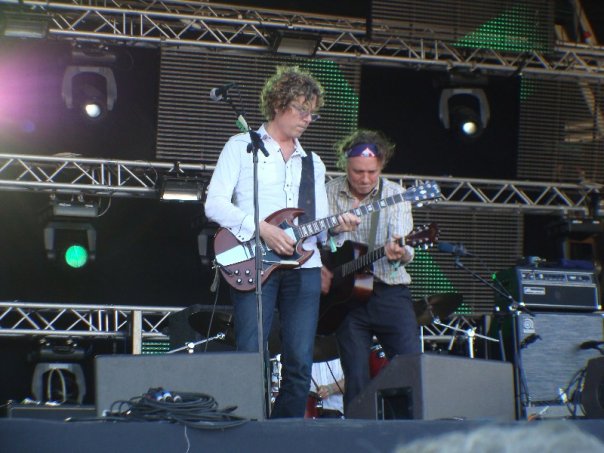 I’d last seen Mark Olson – sometime Jayhawk and one-time Creekdipper – a year ago at the Primavera Festival in Barcelona. That night, before headliners Neil Young and Sonic Youth came on, the Jayhawks were playing, which these days is a rare opportunity not to be missed. Here’s a photo by my friend HarryO of Gary Louris and Mark rocking out in front of the appreciative crowd. They delivered a really good set and, as I’d seen Mark and Gary play together six months earlier, I was uncertain as to whether the Jayhawks were ‘officially’ together again or not, particularly when the two of them released a fine album together, 2008’s Ready For The Flood. Gary and Mark’s parting back in 1995 was none too amicable, as Mark wanted to pursue an earthier, folkier path than he felt the Jayhawks were following, but it derailed the band at just the point where they were becoming big.
The Creekdippers, Mark’s subsequent band, were a good folk-country outfit in their own right, but Mark’s well-publicised divorce from wife Victoria Williams couldn’t have been easy for him (or, to be fair, her). Indeed, his first solo album, 2007’s Salvation Blues, documents some of the pain of those years and can be uncomfortable listening on occasion – in his songs, Mark wears his heart on his sleeve and the music is unadorned and offers no shelter from the emotions being laid bare.
I wouldn’t want you to think that Mark is a doom merchant, as he is friendly and personable on stage, and I was keen to see this show at one of my favourite small venues. He was accompanied, as he usually is these days, by girlfriend and highly talented Norwegian multi-instrumentalist Ingunn Ringvold (who also calls herself ‘Sailorine’) on djembe, harmonium, other percussion stuff and harmony vocals. Mark himself plays guitar and dulcimer, and sings very sweetly. Thanks to The Suit for the photo (left).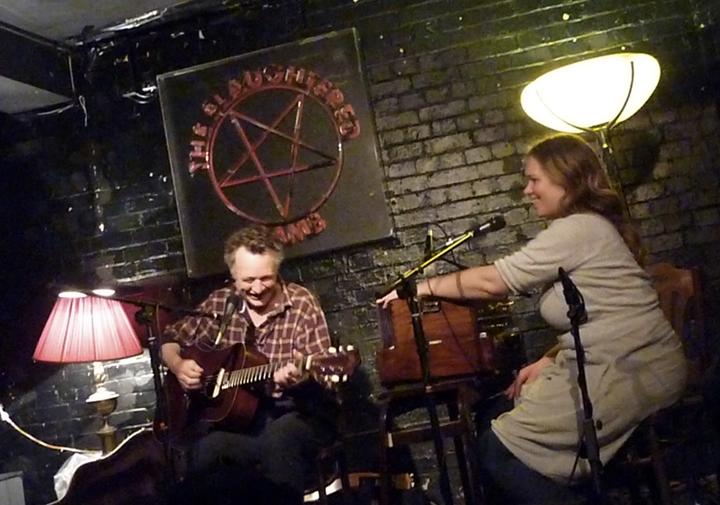
They kicked off with Clifton Bridge, from Salvation Blues, and followed it with a new one, No Time To Live Without Her, from his new album Many Colored Kite, which is out in July. There’s certainly no ignoring of the Jayhawks’ heritage, though, and he immediately gives us Wichita and a stirring Clouds from the band’s first major label album, 1992’s brilliant Hollywood Town Hall. Then we went back even further, with Falling Star from the Jayhawks actual first album, aka The Bunkhouse Album from 1986, long unavailable and now thankfully reissued. Mark said that their manager, who he described as something of ‘a dandy’, contacted him to write ‘an essay’ for the booklet accompanying the reissued album – that was something more than the ‘notes’ he expected to write, but he did it.
Little Bird Of Freedom and Beehive, both from the new album, showed Mark’s trademark songwriting talents – strong narrative and straightforward tunes – and stood up well against oldies like Sister Cry, from Hollywood Town Hall, and the pair’s final encore, Over My Shoulder from Mark’s last Jayhawks album, 1995’s Tomorrow The Green Grass. It had been a friendly, intimate evening and a privilege to be up close to such a fine songwriter.
While I was writing this, I stumbled across one of those serendipitous chains of links that make the online world interesting. I was going to conclude by saying that there’s something about Mark’s demeanour that is self-effacing and modest in a rather un-American way, unlike his long-time partner Gary Louris, who has an easy and confident stage manner… and then I read the Amber Stalker’s blog which quoted my piece about Patti Smith where I talked about “the ingrained British habits of self-deprecation”. This was in his piece about the album Quite Silent by Charlotte Greig – with whom Mark Olson stayed in Wales while writing and making his Salvation Blues album. Circles within circles.
 I was still feeling a wee bit knackered as I wandered into the Grey Horse barely twelve hours after leaving it, but the sun was out, the air was fresh and Young’s Gold was on tap. I settled down with the newspaper until Al the Manc appeared, followed shortly by Peter and James, who looked considerably more knackered than either of us.
This afternoon gig was just a simple set-up in the front bar and the punters were similarly relaxed, sitting at tables and nursing pints. It was clear from the duo’s shell-shocked demeanour that they’d probably been up most of the night. Indeed we eventually heard the back-story, but more of that later… Peter was sporting a little Uncle Tupelo badge and fittingly they started with a cover of that band’s New Madrid, with James on electric guitar, Peter on acoustic and both of them on vocals.
Peter then treated us to another new song about aliens (see last night’s review) which sounded a bit like Femme Fatale. I’m beginning to think he’s serious about the alien abduction dreams. Mind you, this is a man who had a fabulous song on his last album called Hash Dream Craving. Next up was a bleary-eyed version of the old song Moonshiner, as recorded by Bob Dylan:
Let me eat when I am hungry,
Let me drink when I am dry,
A dollar when I am hard up,
Religion when I die.
The whole world’s a bottle
And life’s but a dram,
When the bottle gets empty,
It sure ain’t worth a damn.
This was followed by another drinking song – Tom Waits’s Heart Of Saturday Night – and then a bluesy Miss The Mississippi And You, the old country song first recorded by Jimmie Rodgers and subsequently by Doc Watson, Emmylou, Dylan and others.
 At this point, the two of them ‘fessed up to some of the previous night’s misdemeanours. They’d been staying at Peter’s mum’s house nearby and, at whatever point they emerged in the morning, Peter shouted to James to put the kettle on. James assumed the cordless electric kettle was a cooker-top one, so he put on the gas and watched as the base of the kettle caught fire. The two of them decided to throw it into the back garden and legged it out of the house. All this time, Peter’s mum had been at church, so by the time the gig started, they were apprehensive at the prospect of Mrs Bruntnell arriving home, finding them gone and then discovering the charred remains of her kettle in the garden.
Some of us in the audience reassured them that a replacement shouldn’t cost more than fifteen quid – and even helpfully pointed out that Argos nearby was open until four o’clock. How about that for pampering the stars? After an aborted attempt at Rumble, they instead played the Allman Brothers’ Melissa. James rolled his eyes when Peter suggested it, but they played it nicely regardless. The onstage relationship between them is good, but on occasion James, who is by far the more proficient player of the two, has a wry smile at Peter’s occasional flubs, missed chord changes and misremembered lyrics. Not that it matters, as he clearly appreciates the feeling and soul that Peter puts into the music.
The next bizarre suggestion from Peter, Fairport’s Crazy Man Michael, was swiftly binned, to be replaced by fine covers of two Tim Hardin songs, Reason To Believe and Misty Roses, before which Peter went into an amusing and profane riff about what would have happened if Tim Hardin had entered Britain’s Got Talent… We were now in tragic singer-songwriter mode, as they then played Nick Drake’s Pink Moon and Clothes Of Sand – very sensitively too.
After a truncated version of Sugar Mountain, the mood brightened considerably as friend Rebecca helped the boys out with stirring renditions of Lucinda Williams’ Jackson, and Annabelle, the traditional song recorded by Gillian Welch. Lots more covers and originals followed, punctuated by requests for the England score – the two of them were far from impressed by England beating Japan only thanks to two own goals. I’d be a bit more ‘philosophical’, as football pundits say: all major tournaments should be preceded by injury crises, poor friendly performances, management upheavals, tabloid tittle-tattle and the rest. It’s tradition, innit?
Peter and James eventually ran out of ideas for songs to play, so asked the audience what they wanted. After a couple of wayward suggestions from others, I piped up, “Albuquerque!” (which, believe me, is easier than spelling it) and they duly obliged – just the sort of slow, soulful Neil Young song to round off a laidback afternoon. As it turned out, though, the afternoon hadn’t finished. Al and I had another pint and realised that Peter and James had joined the blues band on the stage in the back of the venue and so we wandered into the back and enjoyed ‘bonus tracks’ Ohio, Fulsom Prison Blues, Happy Birthday Blues and Proud Mary. Very nice.
I’ve been keen to list the afternoon’s songs at some length to emphasise just what a great selection of music you can hear in a pub for free – well, you’re expected to put a fiver in the jug as it’s passed round, but no-one twists your arm. These are the sorts of venues and the kinds of artists that all music-lovers should be seeking out and frequenting. They keep music alive and such occasions can rightfully be regarded as a strand of folk music, regardless of the instruments and the songs’ provenance. I shudder when I think of some of the dull evenings I’ve spent in expensive venues with overpaid stars going through the motions. As Neil Young once sang:
See the losers in the best bars,
Meet the winners in the dives,
Where the people are the real stars,
All the rest of their lives.
Here’s Peter singing Black Mountain UFO from a few months ago:
 A last-minute gig, this one. I’d been rather looking forward to a quiet bank-holiday weekend, but it wasn’t to be, as Peter Bruntnell announced that he was playing at the Grey Horse on Saturday evening with full band and Sunday afternoon accompanied by James Walbourne. How could I refuse? My comments from his gig supporting Richmond Fontaine speak for themselves, so on with the show. Well, not quite – Peter was fiddling with the sound and looking grim. After a bit of toing and froing, he suggested that the PA was so crap that he might nip back to his mum’s nearby to fetch his own PA. Fortunately, the fiddling eventually produced an acceptable result and the band took the stage. Peter and James were joined by James’s brother Rob on drums and Pete Noone on bass, and they launched into oldie 25 Reasons, with the band’s trademark rolling rock reminiscent of Crazy Horse.
After another Neil Youngish song, Here Come The Swells, they played the first of the night’s several cover versions, all of them carefully chosen and righteously if not perfectly executed. The earthy roots gospel of Uncle Tupelo’s Satan Your Kingdom Must Come Down was followed by a fine Down By The River, with some tremendous soloing from James. After another oldie, Have You Seen That Girl Again from the Camelot In Smithereens album, James himself took the mic for the rollicking blues of Jr Kimbrough’s Meet Me In The City, though this version, with its heavier, dirtier sound, is closer to the Black Keys’ version of the song. The band then took a beer break, so we’ll take a breather too with Kimbrough’s song:During the interval, I chatted with friends Ty and Ayesha, pondering over whether or not to go to the Hop Farm festival in July to see Dylan and Ray Davies. I’m still undecided… Meanwhile, the band came back on for the second half and Peter explained that the next song, Black Mountain UFO, was partly inspired by his seeking therapy for having vivid alien abduction dreams… I think he might be serious.
After two more new ones, St Christopher and Ghost Dog, the latter inspired by comic-book author and magician Alan Moore, we got some more very entertaining covers – Fulsom Prison Blues, Like A Hurricane (with another blistering series of solos from James), Do Anything You Wanna Do and Everybody Knows This Is Nowhere. Then James fronted another dirty-blues cover, this time RL Burnside’s Goin’ Down South as reinterpreted by RL and Jon Spencer on the crazily wonderful A Ass Pocket Of Whiskey album. He did so brilliantly and then the band launched into Peter’s Forgiven and By The Time My Head Gets To Phoenix (a marvellous song about cryogenics and parental regret…), both from his Normal For Bridgwater album. Actually, he didn’t manage to get round to the final verse of Phoenix, but who cares? The songs then came thick and fast – originals and covers – until the evening wrapped up with a brutally good Cold Turkey.
The band is simply terrific and there’s definitely no justice in the world. They really should be heard by thousands upon thousands of people who are happy to hear Saturday night music played with heart and soul… OK, skip that – they wouldn’t fit a stadium, never mind Brixton Academy. The best place to see them is in the back room of a pub, surrounded by people who know a good time when they hear one and then have to leg it to the station to catch the last train home. I’ll be back tomorrow, though…

 A Gig's A Gig