Martin Carthy, The Green Note, London, February 17th 2010
 One of the great dynasties of modern English traditional folk music has been the Waterson Carthy clan. The Watersons – siblings Lal, Norma, Mike and cousin John Harrison – were mainstays of traditional, mainly a cappella folk song in the 60s. Here’s the trailer to a 1965 TV documentary about them.
In the early 70s, after John left, they were augmented by Norma’s husband, Martin Carthy, who had made his name in the 60s with Dave Swarbrick, former member of the Ian Campbell Group and soon-to-be Fairport fiddler. In recent years, Norma and Martin’s daughter Eliza has also made a distinctive name for herself and the dynasty looks set to persist.
Seeing Martin perform solo demonstrates how he has spent much of his musical life backing up other singers and tunesmiths. His guitar style is sparse to the point of collapse sometimes, and his singing is not what you’d call top drawer… but of course, this is folk music, so that doesn’t matter. What Martin brings to a show is a lifetime of unique knowledge of songs old and sometimes new. I doubt there’s a performer on the circuit who knows more songs or tunes than him.
Cheerful though Martin is by nature, he’s fond of saying, ‘I don’t do “jolly”‘ and my favourites of a cosy evening at the Green Note were mainly gloom and doom. Bill Norrie is a tragic tale of a terrible secret and Martin sings it beautifully, while Long John, Old John And Jackie North tells the unlikely tale of a 14-foot man saved from hanging by his giant friends.
We did also get some ‘jolly’ this evening, with Three Jolly Welshmen and Cuckoo’s Nest – though the latter piece of ribald filth was in an instrumental rather than sung version. All in all, Martin led us on a very entertaining romp through English and British traditional songs. See him if you get the chance.
A Requiem for Jack Rose, Cafe Oto, London, February 16th 2010
Hush Arbors, Heather Leigh Murray, Voice Of The Seven Thunders, Michael Flower Band, C Joynes
 On what would have been Jack Rose’s 39th birthday, a host of musicians, friends and those like me and Astral who loved his music gathered at Cafe Oto for a ‘requiem’. Perhaps ‘wake’ would have been more appropriate, as the pale ale straight off the barrel soon disappeared as the music started. This was the first time I’d been to the venue, a cheap but friendly space in deepest deprivedest Dalston (dripping pipes included). We need more of these spaces to allow musicians the chance to experiment, explore and share without the pressures of economics and all that drag.
Jack Rose was a force of nature – a big man with a passion for making pizza, friends and amazing music. His mastery of ‘American primitive’ fingerstyle guitar-playing a la John Fahey was second to none, but he was no slave to dry proficiency. And he was no pampered muso either, but a hardworking, big-hearted guitarist who helped fellow musicians and encouraged talent everywhere he went. It’s very touching to see how much he meant to so many people.
Mancunian guitar wizard Rick Tomlinson, aka Voice of the Seven Woods, aka Voice of the Seven Thunders, had the unenviable task of kicking off the evening’s music, and he was clearly nervous. He did manage to weave much of his raga-style magic, though, and eventually turned up the volume in the style of his latest (brilliant) CD.
The Michael Flower Band actually consisted of just Mike Flower – he normally plays alongside a drummer. His gnarly electric guitar distortion belied some beguiling tunes and half-riffs, and his instrumentals widened out into deep sonic territories. I could understand how Jack would have liked this music, despite its obvious differences to his own style. It’s all about feel…
Next up was C Joynes, a dapperly dressed, well-spoken chap from Cambridge who plays a mean resonator guitar in the old blues-ragtime way, but mixes it with some attractively weird sounds and diversions. At one point, he inserted a peculiar fret-stick type thing into the neck to get the strings buzzing and creating odd harmonics and rattles. It was a fine performance and perhaps the closest to the music of Jack – which was not the case with the next act, Heather Leigh Murray, who approached her pedal steel with venom, creating a huge wash of distortion and feedback. Over the top of this noise, she sang in a Patti Smith ululating style. Astral said she reminded her of Nico, which is true – slightly bonkers but very much worth a listen.
The final act of the night was Hush Arbors, aka Keith Wood, a young Virginian who plays laidback indie folk-rock. Tonight he was playing with a five-piece band, who were fine, but it was Keith’s touching memories of Jack Rose that brought the evening back to why we were there – to celebrate a life taken away too soon. RIP Jack.
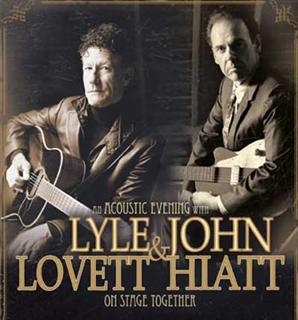 This was always going to be a mellow evening, with two fine singer-songwriters trading acoustic songs and stories, but the evening thankfully packed a punch too – sonically and emotionally.
I first saw John playing with Little Village (the Cooder, Lowe, Keltner and Hiatt ‘supergroup’) at Crystal Palace back in ’92, and his UK connections with Nick Lowe and Elvis Costello have always made me think of him as a rocker rather than a stereotypical singer-songwriter.
It’s unfortunate that, for what I imagine are financial reasons, John tours solo in the UK, as this doesn’t do his songs full justice. In this respect, his acoustic playing and singing reminds me very much of late-era Warren Zevon. Warren also put on a great solo show, but it was even better when he had a band. No matter, John started with a punchy Real Fine Love, and Lyle (who I haven’t seen since I don’t know when) began with a beautiful I Will Rise Up.
Now Lyle suffers from lazy journalists labelling him a ‘new country’ or ‘alt-country’ star. These labels don’t do justice to his fine songwriting and his emotional playing and singing. Just because a man sometimes uses strings, a lusty twang and a big hat, that doesn’t make him the thinking man’s Garth Brooks.
The evening rattled along with a host of car-based songs – John’s Thunderbird, Lyle’s Pontiac and John’s Drive South (which John said had been mistakenly interpreted as having a sexual connotation… hehe….). Then the evening sagged slightly, with a number of overtly bluesy songs. This is partly the problem of doing a two-handed show. Trading songs is fine, but when each joins in with the other’s songs, it can take the playing down to… well, the lowest common denominator, which in my book is play-by-numbers blues. That’s just a preference rather than a strong criticism and it did allow me a toilet break.
The pair then introduced Texas troubadour Joe Ely and the three of them carried on trading songs, the highlights for me being John’s favourites Memphis In The Meantime and Icy Blue Heart, with Lyle’s If I Were The Man You Wanted and Her First Mistake.
The trio came back for an encore which concluded with a fine version of the old Texas prison work-song Ain’t No More Cane.This song has obsessed me for years. I first heard it on The Basement Tapes (in the version actually recorded in the mid-70s with just The Band and no Bob) and then went back to hear Leadbelly’s rendition and Bob’s early 60s version. Subsequently, I’ve heard versions by Lonnie Donegan, Son Volt, Ian Gillan, The Black Crowes, The Band of Heathens and a brilliant, utterly knock-your-socks-off live version by James Walbourne and his band three years ago at the Tapestry Club.
Bruce Jackson’s fine book Wake Up Dead Man: Hard Labor and Southern Blues gives a comprehensive overview of these prison work-songs, but what strikes me about many of them is how un-bluesy they are. With a simple structure, they’re certainly related to spirituals and earlier African songs, but they’re also remarkably similar to old traditional folk tunes from Europe and particularly the British Isles. Hey, as I never tire of saying: “It’s all one song.”
Here are John and Lyle performing the song in Milan earlier this month:
Martin Simpson, The Green Note, London, February 4th 2010
If you want to stir up controversy among folkies, just mention the name ‘Martin Simpson’. Some British folkies peculiarly resent his spending 15 years in the States, while others see his use of ragtime, blues and jazz as lacking that tedious folk authenticity they crave. He’s not easy to pigeonhole, which confuses some people – and as The Suit pointed out, his publicity material includes the quote ‘Widely acknowledged as one of the finest acoustic guitar players in the world’, next to this photo of him…
Then there’s his personality. Two out of the five of us who went along to see him at the cosy veggie cafe the Green Note said they ‘don’t even like him’. I’ve never used that as a criterion for enjoying an artist’s music: so Neil Young is reputed to be ruthless and to drop people when he moves on to something new? I don’t really care…
Martin doesn’t come across as a likeable performer, which is not to say he isn’t courteous, chatty and frequently funny. He just doesn’t do the gushing stuff. I notice that he Twittered this just two hours before the gig: ‘In my usual pre-performance state of turning my give-a-shitter down to manageable levels.’ Which is pretty funny.
For my part, as soon as he starts playing – hell, as soon as he starts tuning up – I forget my reservations about him and feel utterly caught up in the highly emotional nature of his playing. Yes, it’s hugely proficient, but he’s not a tedious pro showing off his chops (unlike acoustic guitarists such as Martin Joseph and Adrian Legg, who leave me cold) – he’s a performer who imbues his songs with real passion.
The evening kicked off with two of my favourites – Home Again, an autobiographical number from his recent album True Stories, and Louisiana 1927, his wonderful take on Randy Newman’s classic song, made more potent by Martin’s own years spent in New Orleans and the fate of that city in the wake of Hurricane Katrina. In fact, it’s so good, let’s take a quick break from my yakking and enjoy this video:
The second half of the show included his fine version of Sir Patrick Spens, which earlier this week won the award for Best Traditional Track at the prestigious BBC Radio 2 Folk Awards. So Martin can do ‘authentic’ when he wishes, although he also does a fine line in cover versions, including Dylan’s Boots Of Spanish Leather and the ‘atheist spiritual’ Come Down, Jehovah by Chris Wood, who’s another unlikeable folkie whose music I like.
His own highly personal song Never Any Good, about his father, is beautiful, funny and touching. It was the highlight of a tremendous show. Go and see Martin if he’s on a stage near you.
Gandalf Murphy and the Slambovian Circus of Dreams, Dingwalls, London, February 3rd 2010
Yes, they are as weird and wonderful as their name suggests. Despite some proggish tendencies, Gandalf Murphy are enormous fun… and we could all do with some of that. The band hails from Sleepy Hollow, NY, and consist of the permanently be-hatted Joziah Longo, his wife Tink, their son Orien on bass, Sharkey on guitar and Tony on drums. Fun Fact: the bass player with Joziah’s previous band, The Ancestors, is currently with Public Enemy.
Their unusual tendencies are typified by the range of items available in their online store, which include their own brand of chocolate as well as some exclusive Slambovian coffee. Mmmm….
I first saw them at the Rhythm Festival last year and was charmed by their folky, rocky, psychy, poppy mixture. They’ll try their hand at anything, as they proved in front of an appreciative (and well-lubricated) Dingwalls crowd.
First up was Sunday In The Rain, from 2004’s Floyd-influenced album Flapjacks From The Sky, followed by Pushin’ Up Daisies, from 2007’s fine album The Great Unravel. Then Tink unveiled her splendid theremin and made suitably UFOish noises during audience favourite Flapjacks From The Sky. The first of two long sets finished with the mighty driving rock of Trans-Slambovian Bi-Polar Express, which has to be one of my favourite song titles.
The second half veered gloriously all over the musical landscape, with added banjo, harmonica, some Slambovian yodelling, more theremin, a Dylan cover, a Beatles song and even a traditional Slambovian Christmas carol.
My gig buddy The Suit was very excited when I told him about the iPhone theremin app. I suspect he downloaded it right after the show…. this is what technology was made for, I’m sure you’ll agree.
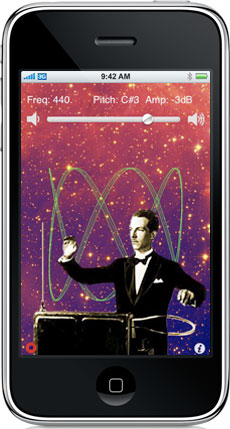
The iPhone theremin app
Smoke Fairies, The Lexington, Islington, London, February 1st 2010
I first saw Smoke Fairies – the existence of a prefix ‘The…’ is disputed – at a free show before the BBC Young Folk Awards in 2007. I was impressed enough to drag Astral along to see them play at Powers’ Acoustic Room in Kilburn a couple of months later. The venue is no longer there (it’s just a drinking hole now), which is no surprise, as there must have been all of twelve people in attendance. Smoke Fairies’ blend of folky blues, impressive guitar-playing and fine harmonies was intriguing, and their dark, smoky music is something of a contrast to their appearance as… well, a pair of thoroughly nice young women.
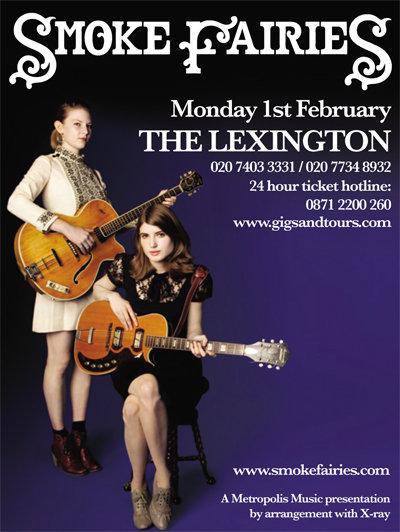 Have a look here if you’re after some background on where they come from and what makes them tick, but suffice it to say here that any band who cites CSNY and Skip James as key influences must have something going for them.
This was the first time I’d been to The Lexington and I was very impressed. It’s a properly cleaned-up rather than done-up boozer, with a good upstairs space, excellent sound – and Sierra Nevada Pale Ale on tap. This put me in a good mood for seeing the new incarnation of Smoke Fairies, with added fiddle, drums and bass. I feared that this would render their sound less interesting – a fate which has befallen several artists I’ve liked who’ve gone on to ‘better things’; that’s to say they’ve signed to a record company that insists on a bigger, more commercial sound, yadda yadda. A few examples would be The Unthanks, John Smith and Findlay Brown, all of whose future output I’m less likely to look out for than I did before they signed significant deals. Oh well.
My fears about Smoke Fairies were washed away by tonight’s performance, which was an excellent mix of the old two-handed swampy blues and the new full-band gutsy blues-rock and folk-rock numbers. All this hyphenation is unfortunate but necessary – their sound is quite unique, though firmly rooted in all the great traditions of modern popular music.
Their inter-song banter continues to be endearingly unsure of itself, but that didn’t deter a very enthusiastic sell-out crowd from cheering those Fairies to the rafters. Here’s a video of them performing Gastown from the show:
Midlake, Wilton’s Music Hall, London, January 31st 2010
I was mildly diverted by Midlake’s breakthrough album The Trials Of Van Occupanther (despite its unwelcome over-reliance on 70s Fleetwood Mac and Genesis) and intrigued by their as-yet-unheard new album, The Courage Of Others, which has been described as heavily influenced by late 60s and early 70s British folk-rock. Reviewers have raved over both the band and the new CD, so I went along to Wilton’s Music Hall just east of the City to see what all the fuss is about.
In truth, I was more impressed with the venue than the band… Wilton’s Music Hall, built in about 1858, is a wonderful survivor of a bygone era of thriving local live entertainment. What’s extraordinary is that the building’s structure is just about intact, but there’s little left of the décor. Bare walls and floors give little away about the original look of the hall, which makes it even more atmospheric. Sadly, though, the building is falling down, so please give them some cash if you can spare it.
Midlake entered this romantic gloom and played three new songs from the new album followed by two biggies from their first album, Roscoe and Van Occupanther. So far, so OK – although front-man Tim Smith even bears an eerie resemblance to a young, fuller-of-face Mick Fleetwood. The new songs are quite Tull-like, with an inflection of Fairport and Steeleye Span, but after a few more of these songs, my attention began to wander.
The duelling flutes were on occasion very attractive, but the whole thing is wrapped up in too much of an austere, reverential approach to British folk-rock. The band is from Denton, Texas, so I assume the English countryside is indeed a very foreign place, but reverential is wrong. Hell, all the Fairport fans I know slag them off mercilessly from time to time. Theirs is not a tradition we need to painstakingly preserve. Instead it’s one I want to celebrate but appreciate that it moves and changes with the times. The only preservation I wanted to see this evening was of the beautiful hall we were in.
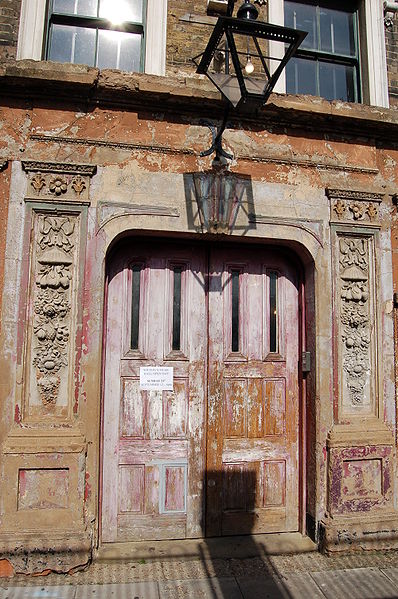
Wilton's Music Hall
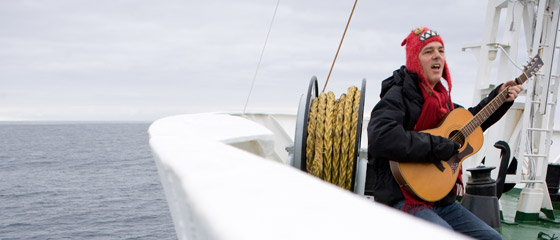
In 2008, surrealadelic troubadour Robyn Hitchcock visited the Arctic in the company of other artists, musicians and writers to see for themselves the effects of glaciers retreating due to climate change. You can read his musings about the experience here, but tonight’s show spotlighted his musical responses to the trip and took us on a journey through maritime songs old and new.
The evening kicked off with Robyn singing his own song The Ghost Ship, followed by traditional seafaring song Polly On The Shore. Despite Robyn’s modest admission that his guitar-playing on the latter song would be inferior to Martin Carthy’s version, I think it’s often overlooked how good and expressive a guitarist Robyn is.
He was then joined by lusty folk-singer Kathryn Williams (heavily ‘with child’) for a gentle version of her Winter Is Sharp, followed by a rousing rendition of The Ballad Of Easy Rider, for which they’re joined by a full band. Robyn then turned to two sea-related songs of his own, The Wreck Of The Arthur Lee and Luminous Rose. The first half of the show was rounded off by a shaky but moving duet of traditional sailors’ song The Bay Of Biscay.
These one-off events can often be spoiled by a lack of focus or indeed a lack of rehearsal, but the rough edges don’t really matter in this case. As Robyn said, in one of his many surreal inter-song monologues, the evening was meant to be liquid rather than cut-and-dried like the ghastly thrusting angular shoulder-padded 80s…. Yes, he went off on one.
For the second half, Robyn donned his trademark polka-dot shirt (his shirt for the first half was a surprisingly restrained blue floral number) and launched into his song Oceanside. Special guest Graham Coxon then took centre stage for a very pretty Brave The Storm, followed by a full band Caspian Sea, which bloomed into a droning proggish epic. Robyn followed that perfectly with a hypnotic hazy version of the Velvet Underground’s Ocean.
The last special guest, KT Tunstall (who was also on the Arctic trip), now took to the stage to sing a fine a cappella ‘whale song’ which she’d written on the trip and premiered another new song with Robyn.
After a few more lusty shanties, the evening finished with a group rendition of traditional West Indian shanty Shallow Brown. Robyn encored brilliantly with his old song Underwater Moonlight in all its squiddy glory:
“He was pink and she was pink
And onward they did row,
Didn’t see the giant squid, though,
It was fairly slow,
When they hit the bottom they were well and truly dead,
The statues took their place, and then they rode back home instead…”
A bon voyage was had by all.
Joe Pernice, Union Chapel, Islington, January 26th 2010
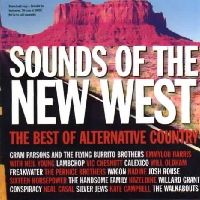 Freebie covermount CD Sounds Of The New West came stuck to the September 1998 issue of Uncut and can claim some credit for the growth of alt-country in the UK. It included oldies such as The Flying Burritos and Emmylou, but it also showcased newcomers (to me at least) including Will Oldham, The Silver Jews, Willard Grant Conspiracy, the late Vic Chesnutt – and the Pernice Brothers, with their song Crestfallen. I bought a stack of new CDs on the back of that one free disc, including the Pernice Brothers’ Overcome By Happiness.
Founder member Joe Pernice has also occasionally recorded solo as well as spent much of his time writing. In 2003, his semi-autobiographical book Meat Is Murder was published and last year saw the publication of his novel It Feels So Good When I Stop.
One attraction of the Pernice Brothers for me has been the presence in the band of James Walbourne on guitar (notably on the live CD Nobody’s Watching/Nobody’s Listening), but I’ve never seen Joe live before, so it’s a new one for me.
Joe is a laidback performer, but his well-crafted songs are often intense. He’s quite a big man and funny with it too. He talks of his Italian roots (I suppose the name was originally pronounced ‘pair-knee-chay’ rather than ‘pun-eace’…), and onstage he has a range of slightly neurotic tics and twitches – a sort of cross between Antonio Carluccio and Woody Allen, if you can picture that.
He’s a good but not great guitar player and I began to wonder if he could hold an audience’s attention all evening with just voice and guitar. Wisely, he mixed things up by inviting local lad James Walbourne to join him (on guitar and piano) for three songs, including a very heartfelt version of I’m Your Puppet, which I’d heard James play just a couple of weeks ago. Joe’s new songs hold up well against the older material and the audience showed its appreciation for a fine evening.
Top tip: if you go to the Union Chapel, be sure to get there early so that: 1. You can reserve yourself some good spaces on the austere pews; 2. You can get yourself some of the delicious homemade food they serve in the bar at absurdly cheap prices. Before the gig, my friend the Noble Savage enjoyed a zingy curry while I tucked into a tasty cheese and onion quiche.
Here for your enjoyment are James and Bobby Purify singing my favourite version of I’m Your Puppet (written by the great Spooner Oldham).
David Thomas Broughton, The Windmill, Brixton, January 24th 2010
A weekend email from Tim at The Windmill told us that David Thomas Broughton was Sunday night’s last-minute booking. Astral and I were keen to go as we’ve been fans of David’s ever since our jaws dropped when we first saw him. Nothing quite prepares you for a DTB gig (apologies for the annoying acronym, but it really does save time for my imprecise typing fingers).
He’s an accomplished classical and folk guitar picker who uses his loop/delay pedal to create swirling or juddery rhythms that soothe or unsettle, depending on mood and, quite possibly, chance. When he sings, it really starts to sound strange and different. His clarion voice – a Yorkshire baritone – is looped endlessly and begins to sound like an unearthly choir.
What’s more, DTB moves not just around the stage, but off the stage and into the audience, occasionally knocking himself on the head with his microphone – the sound of which is then incorporated into the rhythm of the tune. When we saw him play in the elegant St Pancras church in Euston a couple of years ago, he took great delight in climbing the spiral steps of the pulpit mid-song and declaiming like some demented folktronic preacher. Excellent stuff.
Tonight DTB was filming a video for his new record, but it didn’t seem to cramp his style. Most of his songs, if you manage to catch the lyrics, are about love or poverty – one of his finest, Weight Of My Love, complains that he ‘can’t afford a pasty from the Greggs bakery’. Making this sort of music won’t earn him much in the way of pasties, but DTB’s an unsettling, amusing and compelling performer.
Oh, and support came from one of my local favourites, the Boycott Coca Cola Experience – a one-man band of primitive plucked blues underscoring surreal tales from South East London. See him now before he gets bigger than Jesus. Well, possibly taller, anyway…

 A Gig's A Gig