The Besnard Lakes, Cargo, London, March 31st 2010
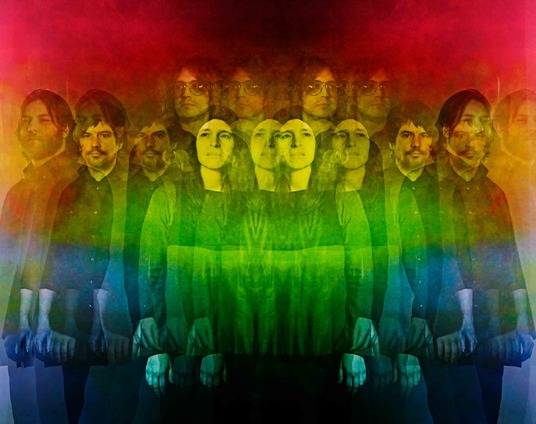 Three years ago, I saw Montreal band The Besnard Lakes at Water Rats, which is one of London’s smallest venues. It was memorable partly for their successful efforts to get all six of them – with their instruments and equipment – onto the tiny stage. They’d just released their highly acclaimed second album The Besnard Lakes Are The Dark Horse and we were keen to see how they could reproduce their hazy, pseudo-symphonic 70s rock music live.
Now though, with a new album The Besnard Lakes Are The Roaring Night, they’re down to a four-piece, fronted by founding husband-and-wife team Jace Lasek on guitar, vocals and MacBook Pro, and Olga Goreas on bass and vocals. I braved a trip to trendy venue Cargo to see if and how they’d changed. Cargo is one of those places that make me feel old – tinned beer, shouty young crowd taking mobile phone pictures of each other, and a crappy sound system.
Thankfully, The Besnard Lakes rose above the annoying environs and delivered a powerful set of droning, spacy songs with a real edge. In their previous incarnation, my main reservation about them was a certain lack of focus in their songs. There was a lot going on, but sometimes there was too much. Now with just four of them, the sound is more clearly defined (even when fuzzy) and harder. I liked it.
Through an absurd cloud of 70s dry ice, Like The Ocean, Like The Innocent was a powerful start to the set – high ethereal vocals, psychedelic guitar and swirling computer-driven space sounds. There is something quite shoegazy about them and on several occasions I was reminded of My Bloody Valentine and even the Cocteau Twins, but they also wisely get heavier from time to time. In fact, Olga’s bass playing is very ‘urban’ and dubby, and there’s a funky element to many of the songs that perhaps is missing on record.
Devastation is a great rock tune and they deliver it with vehemence and defiance, while latest single Albatross is a more laid-back piece of spaced-out drone that Kevin Shields would be proud of. You can download it for free here.
They’re not talkative bunch and at one point Jace apologises for resembling a child molester – in a certain light, he does look like he could be one of the Royal Tenenbaums… He also exhibits a few nervous twitches and likes fiddling with his Mac, but I guess geeks rule the world nowadays, so why not the stage at Cargo?
The climax was the dreamy highlight of their ….Dark Horse album, For Agent 13, sounding at times like a Badalamenti score for David Lynch. Here’s the ‘official’ video – I’m off to find some non-tinned beer.
 Big Sis had been staying since the previous Wednesday, so I wanted to keep on packing in the gigs for her. She thought twice about getting the train out to Kingston on a Sunday afternoon to see a bunch of middle-aged blokes play covers in a no-frills pub, but thankfully she said ‘yes’.
Astral, The Suit, Al The Manc and I had seen 14 Cousins here last year and had had a fine afternoon (it’s a Youngs pub, so there’s no problem with the beer), the main draw being their lead guitarist, the splendid Peter Bruntnell (see blogs passim). The other members of the band are good, too, and essentially they’re a fine covers band, as no-frills and entertaining as the pub itself.
What we got was nearly four hours of great music, with lots of toe-tapping and singing along. Here’s the (incomplete) setlist to show you the breadth and quality of the music on offer…
First set:
Tulsa County (The Byrds)
Friend Of The Devil (Grateful Dead)
The Heart Of Saturday Night (Tom Waits)
From A Buick 6 (Bob Dylan)
Fulsom Prison Blues (Johnny Cash)
Cinnamon Girl (Neil Young)
Passenger Side (Wilco)
Second set:
Alberta, Alberta (Eric Clapton)
Watching The River Flow (Bob Dylan)
Wichita (The Jayhawks)
Powderfinger (Neil Young)
Up On Cripple Creek (The Band)
Heart Of Darkness (Sparklehorse)
Last set:
That Was Your Mother (Paul Simon)
The Girl Of My Best Friend (Elvis Presley)
Jump, Jive And Wail (Louis Prima)
Into The Mystic (Van Morrison)
My Back Pages (Bob Dylan)
I’m Not That Cat Anymore (Doug Sahm)
The Shape I’m In (The Band)
Man In The Long Black Coat (Bob Dylan)
Ohio (Neil Young)
Cold Turkey (John Lennon)
Sometimes a great afternoon just consists of good company, good beer and great music, and this was one of those occasions, topped off by a swift pint in the Hole In The Wall when we got back to Waterloo. Cheers!
Here are 14 Cousins from last November in the same venue, playing Sparklehorse’s Heart Of Darkness followed by Wilco’s Passenger Side (complete with amusingly pissed headbanger in the background):
 The rundown Deptford Arms is the venue for the Kit And Cutter folk club, though they’ll soon need to look for new premises – the dive is to become a Paddy Power bookmakers shop. Then the hard-up locals can waste their money dreaming of escape rather than drinking to escape. Tonight’s guest at the Kit And Cutter, Scottish singer and guitarist Alasdair Roberts, proves to be a big draw and the tiny back room is packed.
Alasdair divides his time between traditional folk songs (usually tragic ballads) and his own compositions, both strands being bewitching and compelling. Indeed, his albums have alternated self-penned and traditional numbers, though the last two albums have comprised just his own songs, perhaps signalling a gradual departure from the trad folkie path.
He performed wonderfully tonight, accompanied at times by fine fiddle-player Elle Osbourne, and his delivery held the audience in a pleasant spell. Listening to his songs is easier than describing them, but they are broadly quiet and reflective, interspersed with dense images and obscure language, not just Scots words, but archaic English and foreign ones too – ‘simulacra’, ‘sistrum’ and ‘sarcophagi’ sit happily among his lyrics. Here’s an excerpt from Riddle Me This which demonstrates his exact poetic sense:
Who were the ones who first gathered the amber
To render the embering dawn of the day
The stallion in canter, the river in meander
So we’d remember them long after they fade away?
And how could they know as they measured the seasons?
How could they know as they furrowed the soil?
Of all the dishonour and all the unreason
And all of the wrong to be done in the name of their toil?
The next song, Farewell Sorrow, is a fierce look at war, death and fearlessness, while The Laverick And The Blackthorn shows his attraction to ornithology as well as obscure language – ‘laverick’ or ‘loverock’ is a northern dialect word for a lark. An idle moment on the bus affords me time to make a quick list of Alasdair’s feathered songs – Waxwing, The Magpie’s Nest, The Book Of Doves – and those that make mention of cranes, geese, ravens and more larks.
Among tonight’s highlights are seafaring doom-shanty The Daemon Lover, the old anti-semitic song Sir Hugh, Or The Jew’s Daughter (which I’d last heard live sung by Sam Lee back in January when I began this blog) and closing tune The Haruspex of Paradox. It’s a fine evening, but being tucked away in the back of dodgy pub made we wonder about Alasdair’s wider appeal. He was something a protégé of Bonnie ‘Prince’ Billy, who has gone on to fill large theatres and sell respectable numbers of records. It’s not obvious to me that Alasdair’s work is much inferior to Billy’s and yet, bar the occasional outing to a big venue for one of those multi-artist tribute bashes, he plays tiny folk venues. My suspicion is that he is happier in the more collaborative and relaxed folk-club environment rather than the larger world of performance. But I might be wrong….
Many thanks to the Amber Stalker for the setlist info – here are Alasdair and Elle performing The Daemon Lover on the night:
Nick Harper, Union Chapel, Islington, March 26th 2010
I wonder if it would be possible to review a Nick Harper gig without using the words ‘folk’ or ‘Roy’. As I’ve already failed in that task, please let me explain: Nick Harper is an acoustic singer-songwriter in the percussive-rock and picking styles. He is not a folk musician – I’ve never heard him sing a traditional song or play a traditional tune – but it’s much easier for idle reviewers to see the guitar, hear some picking and slap a big ‘FOLK’ label on him.
Of course, this is true also of his father, Roy, with whom Nick is inevitably and pointlessly compared. What he does share with his father is a confidence and assurance about his music that borders on arrogance – and a pathological hatred of fossilised forms of authority, particularly governments, armies and organised religion. Which suits me fine. This fiercely humanist/pagan attitude to life makes a Nick gig at the Union Chapel even more compelling, as it’s still a consecrated place of a worship, rather than just a nice old building like the deconsecrated venue St Luke’s Church on Old Street.
After kicking off with oldies A Hundred Things and Shadowlands, both from his debut CD Light At The End Of The Kennel, it’s into his funny and wonderfully written historical piece The Field of the Cloth of Gold. In fact, here it is from the gig, complete with dodgy tuning and silly rambling intro, both of which are essential Harper features…
The next song, Evo, is Nick’s tribute to Bolivia’s radical president, Evo Morales, although the political ranting has been kept to a minimum this evening. The more personal stuff is always more powerful and the next number, Blood Song, is one of my very favourites – a deeply moving song about the fundamental ties that bind across and down the generations.
Other, more uptempo, favourites come thick and fast – Love Junky [sic], Aeroplane and more – followed by another stunner, Bloom, a heart-wrenching (and, according to Nick, true) account of child abuse. The guitar-playing is simple and the vocals out-of-this-world – Harper’s falsetto turns into a high, wailing cry of pain and a scream for justice. It’s not easy listening, but he follows it incongruously with one of his prime pieces of silliness, Eric Idle’s Galaxy Song – and yes, he can remember all the words.
The cornerstone of most of Nick’s gigs is the epic Building Our Own Temple, which gives him the opportunity to show off his guitar skills and vocal playfulness while singing out the most defiant anti-religious song. As it drives along, samples of other songs come in and out of the wall of sound – Led Zeppelin’s Friends, Holst’s Mars, Kool and the Gang’s Jungle Boogie and Public Enemy’s Don’t Believe The Hype. Now you should be able to tell that Nick’s no folkie…
The evening winds up with the expertly crafted story of birth to death, By My Rocket Comes Fire, and he encores with oldie Radio Silence. Nick’s not to everyone’s taste (The Suit avoided this one like the plague), but I admire his pugnacious, cocky attitude, his guitar-playing and some damn-fine songwriting. My advice to the unconverted: skip the studio albums and go and see him live. Here endeth the lesson.
Tunng, The Garage, London, March 25th 2010
 Folk-rock-electronica-beats band Tunng have been firm favourites in our household, hence a full family turn-out for this gig. 2005’s Mother’s Daughter And Other Songs was a brilliant debut, but recent CD And Then We Saw Land… , their fourth, marked a change in direction. Gone is co-founder Sam Genders and with him a lot of the left-field, folky nature of their sound. The new album is poppier, rockier and more ‘anthemic’ – which I’m not sure is a good thing, so I was interested to see how their live show might have changed.
They have certainly become more confident on stage and their singing and harmonising is surer than it often was in the past. Mike Lindsay is an affable front-man and jovially led the audience into some singing along early on, with new song It Breaks. Other new songs share this campfire approach – Don’t Look Down Or Back and Santiago in particular – but it’s the less accessible new material that attracts the ear. Sashimi is a weird mix of beats, guitar and all sorts, while October is more hushed and reminiscent of their earliest stuff.
 Mike indulged his ‘rock god’ fantasy by donning absurd Elton-style sunglasses and posing through the solo in By Dusk They Were In The City, but it’s co-singer Becky who’s more to the forefront vocally these days. Certainly her voice has matured over the last few years and is strong enough to take the lead without Mike’s vocal support.
Tunng suffered the usual nuisance when showcasing new material in that the older songs got the biggest cheers, so it was no surprise that the crowd bobbed merrily up and down to favourites such as Woodcat and Jenny Again. And Bullets is a great sing-along to send people home happy, but I’m more interested in the newer stuff that works better live than on CD. And on that score, recent single Hustle and the meandering, Latin-tinged Weekend Away promise intriguing developments ahead. Here for your pleasure is the official video for Hustle:
Crooked Still, The Borderline, London, March 23rd 2010
 I’m not a fan of makeovers, so I approached this evening with some trepidation, as The Suit and I were going to be exposed to not one, not two, but three makeovers. First, some fool decided that Greek Street’s inestimable boozer The Pillars of Hercules – always good for a pint or three before a show at The Borderline – needed a fresh start. Second, The Borderline itself – a wonderfully ramshackle basement venue showing its roots as part of 80s Tex-Mex restaurant Break For The Border – was shut for a while to undergo a ‘refurbishment’.
And finally, young Boston bluegrass band Crooked Still have undergone a makeover since I last saw them – which, in truth, was two-and-a-half years ago, but even so… They’ve lost a phenomenal bluegrass cellist (yes, really) Rushad Eggleston, but gained the services of another, Tristan Clarridge, plus fiddle-player Brittany Haas.
Anyway, first stop was The Pillars of Hercules, which still smelled of paint, though actually they haven’t done a lot to the place – smaller and smarter tables, poshed-up menu and so on – but putting a skylight into the ceiling above the back area is a big mistake. Sometimes people want to escape to the gloom and maybe not want to see each other clearly – or indeed be seen by others. So, the first makeover gets a thumb neither up nor down: they haven’t ruined it, but what they have done is pointless.
And now to The Borderline…. there’s a tiny extra bar been added next to the bottom of the stairs, which have lost their historic gig posters – I only hope they’re going to put them back. And the cloakroom has been moved right over to the far side next to the merch table, which isn’t actually horrible, but the stage’s backdrop most certainly is. Here’s a picture of how the stage has always looked (from a Dar Williams gig last year):

Distinctive, yes? Well they’ve put a stupid burgundy velvet curtain behind the stage, so it looks like any old venue now. Grrrr…. so thumbs down to The Borderline’s makeover.
And Crooked Still? A thumbs up, happily. Tristan Claridge’s cello is a worthy successor to that of the phenomenal Rushad, and Brittany Haas plays a mean fiddle. Add to that the briliant banjo-playing of Greg Liszt (you may have seen him play in Bruce Springsteen’s Seeger Sessions Band) and the fine voice of Aoife O’Donovan and they’re onto a winner.
I failed to make any notes during the gig, as The Suit and I were enjoying the Newcastle Brown at the tarted-up main bar, but highlights were a cracking version of Robert Johnson’s Come On In My Kitchen and a fierce, funky Ain’t No Grave. Undone In Sorrow was cool and wistful, while The Lovesick Red Stick Blues raised a smile.
Crooked Still are young, ambitious and very talented, and perhaps there’s a wee bit too much polish in some of the rougher bluegrass numbers, but they certainly deliver a great toe-tapping night out. Here’s the lovely Orphan Girl from RTE’s Late, Late Show a few days ago:
Patti Smith, Union Chapel, Islington, March 21st 2010
 I’ve seen Patti Smith several times over the years, but I’d forgotten one aspect of her performances until my friend Mom Of Kong from the States reminded me, ‘She hacks ’em up like a truck driver… so stand or sit five or so rows back and have a blast!’ Indeed, she does have a wonderful way of clearing excess spittle, shall we say. Patti the punk-art poetess has never been one for the niceties, but there’s something else about her that I want to reflect on later – it’s her absolute seriousness as an artist.
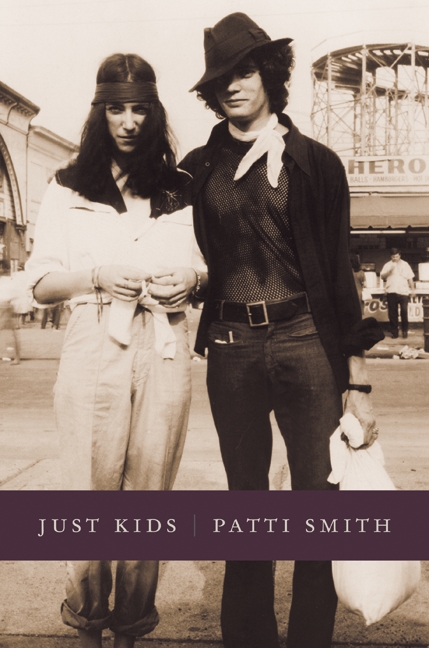
Patti’s on tour promoting Just Kids, her memoir of life in New York with the photographer Robert Mapplethorpe, and much of tonight’s gig was taken up with her reading extracts from the book. What struck me was how personal, humorous and relatively light the memoirs are – relatively light compared to her songs and poetry, that is. The musical tone was set with the opening number, a stripped down, austere My Blakean Year, followed by the chugging drive of Redondo Beach, with Patti spitting out the lyrics.
She was joined by band member Tony Shanahan on acoustic guitar and piano, and – after a fine Wings – by My Bloody Valentine main-man Kevin Shields, also on acoustic guitar. This was possibly his quietest gig for a long time, though Patti enjoyed the righteous ranting of Birdland:
Take me up, daddy, to the belly of your ship,
Let the ship slide open and I’ll go inside of it
Where you’re not human, you are not human.
She followed that with a touching recollection of Robert Mapplethorpe’s last days and I felt pulled again by a nagging string of thoughts about art, artists and America. I’ve always had a fascination for the art of postwar USA, whether it’s the paintings of Rothko and Johns, the poems of Ginsberg and Berryman, or the music of Cage and Glass. But what these have in common is a seriousness, an austerity, about their vocation that borders on the solemn and quasi-religious.
Now you can argue the toss about how ‘the muse’, artistic inspiration and discipline share much with spiritual belief and practice, but the world of postwar metropolitan modern art in America seems to me a strangely humourless place, peopled by artists whose apparent distaste for the real, grimy world often led them either to severe austerity or headlong into hedonistic enjoyment of what ‘the streets’ had to offer.
 We in Britain had little of this ethos, not only because postwar Britain was grey and relatively dull, but also because of the ingrained British habits of self-deprecation, mocking humour and a real fear of being seen to be pompous. And there is something ever so slightly pompous about Patti’s name-dropping – Blake, Rimbaud, Apollinaire, Ginsberg and the rest – but it’s also quite touching (the same goes for Lou Reed and his reinvention as A Serious Artist rather than brattish rock-star). I’d go so far as to say it seems to be a defence mechanism, with Patti holding up cherished books as fetish objects against the ugly philistinism of American consumer culture.
I don’t think for one moment that Patti needs to be defensive about her art – it’s just that I think she sees her important work differently. I love the rant of Piss Factory, for instance, but much of Patti’s strident poetry leaves me unmoved, as do (whisper it softly) many of her songs. Her anecdotes, observations, stories and memoirs, however, are a different matter: pertinent, emotional, personally brave, funny, beautifully written and shining with the simple ring of truth.
So perhaps Patti herself is the object and purpose of her art. Her life of truth-telling and singing is more important and valuable than the works themselves. This was, I think, also true of a great American postwar artist not mentioned above – Andy Warhol, whose crowning achievement was his own path through life. Here’s to Patti and her life.
Finally, despite myself, I can’t resist a little bit of her ranting in an outtake of an interview she gave in 2002… ‘You don’t need anything…’
Norma Waterson, Martin Carthy and Chris Parkinson, The Goose Is Out, DHFC, East Dulwich, March 19th 2010
From the daughter of the clan last night to the mother and father tonight… Our local folk club, The Goose Is Out, is only a couple of years old, but we’ve had many of the greats of British folk come down to the bar of Dulwich Hamlet FC, and they don’t come much greater than the husband and wife duo Norma Waterson and Martin Carthy.
Norma has been unwell recently, so it was lovely to see her back on the stage. She was the driving force behind The Watersons, a remarkable folk-singing family from Hull comprising Norma, her siblings Elaine (‘Lal’) and Mike, and their cousin, John. A dated but fine TV documentary from 1965 shows them in action and here’s a clip from it of them with fellow singers Louis Killen and the wonderful Anne Briggs:
Check out all the other clips there for a great look at a bygone era. Anyway, Norma and husband Martin Carthy were joined tonight by Chris Parkinson on melodeon and backing vocals. The evening’s entertainment had much variety, with solo songs from Norma, accompanied songs from Martin, instrumentals from Martin and Chris, and all three singing together, and great fun it was.
What dawned on Astral and me after the show was how un-folky they often are. As entertainers, theirs is not the world of joining in well-known traditional songs in a collaborative way. Although that’s part of their act, they also unearth songs and tunes from all over the place and perform them for an audience — tonight, for example, I counted at least five American songs (even if their roots can be traced back to these isles). The first of these, Bright Shiny Morning, is a variation of both St James Infirmary and Streets Of Laredo, while another was the excellent sing-along cowboy song Blue Mountain — and Martin and Chris even threw in a New Mexican-Apache tune called Peanut Shoes. Other songs included ghost stories (The Bay Of Biscay), tales of forbidden love (Clyde’s Water) and well-known folky music-hall numbers (A Bunch Of Thyme and Green Grows The Laurel).
With such variety, it’s clear they’re not like other folk greats. They have a more urban as well as global focus, so perhaps their musical ancestors were really the stars of 19th- and early 20th-century music hall rather than farming folk gathered in a rustic pub. Thus despite the appearance of a more traditional English focus, they’re in reality just as outward-looking and curious about other people’s music as their daughter Eliza is. Which is how it should be. Here are Norma, Martin and Chris performing Bright Shiny Morning in Lewes the day before they came to East Dulwich:
Eliza Carthy, Water Rats, London, March 18th 2010
It’s a pain to read reviews that barely mention the music… but I’m afraid I’m going to be a pain this time – for what I think is a good reason. On January 16th, The Guardian published this snidey piece of crap under the subhead, ‘We reveal which artists fill up the iPods and Spotify playlists of the world’s most evil men’:
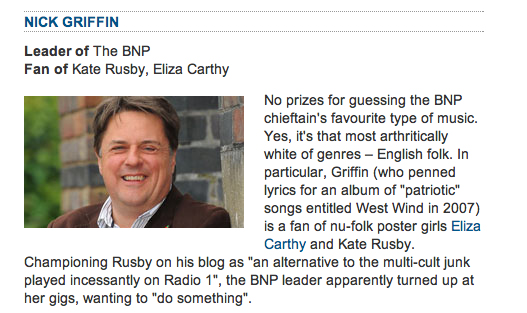
The author of this lazy rubbish, Christian Koch, did mention that the umbrella group Folk Against Fascism had been set up expressly to counter this BNP bollocks, but the muck had already been well and truly raked. Here’s what FAF say about themselves:
The UK folk scene is a welcoming and inclusive one; folk music and dance have always been about collaboration, participation, communication and respect. Folk Against Fascism has been created to take a stand against the BNP’s targeting of folk music, a stand against the appropriation of our culture. Folk Against Fascism isn’t a political party or a bureaucratic, top-heavy organisation. It is any and all of us who want to make ourselves aware of the BNP’s bigoted view of our history and culture, and who want to do something about it.
The BNP want to take our music, want to twist it into something it isn’t; something exclusive, not inclusive. We must not let them. Folk Against Fascism is a way to demonstrate our anger at the way the BNP wants to remodel folk music in its own narrow-minded image.
Eliza Carthy went further and got a ‘right to reply’ which is worth reading in its entirety, but here are some pertinent bits:
The thing that really bothers me about Koch’s piece, however, is when he says: ‘No prizes for guessing the BNP chieftain’s favourite type of music. Yes, it’s that most arthritically white of genres: English folk.’ These words offend me with their ignorance and prejudice. Ancestral music is blameless in this, and what does my ancestors being white have to do with anything if civilised people know that race is irrelevant?
…. At the moment I’m touring with the Imagined Village, an English folk band that includes British Asians alongside guests such as Billy Bragg and Benjamin Zephaniah. You mentioned Folk Against Fascism: we support their attempts to distance folk music from the far right. Bollocks to Nick Griffin. And because talk is not cheap when it comes to this, bollocks to Christian Koch. It’s just not funny.
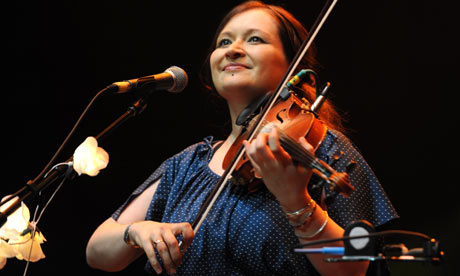 Yay, Eliza! I’m not going to rant too much here, but I’d love to hear the response from The Guardian if someone complained that bhangra was ‘too Asian’, or grime was ‘too black’, or jigs and reels were ‘too Gaelic’…Pah, a pox on ’em and their pathetic ‘liberal’ veneer.
And now to the music (with a number of barbed cultural references chucked in for cheap rhetorical effect). The audience – old and young, black and white – was sweating up a storm in the tiny back room of grungey Water Rats when Eliza Carthy (Gypsy-Yorkshire mother, London-Irish father) and her band took the stage. She started with a slow number from her forthcoming album, a soulful bluesy ballad called Thursday, followed by Little Bigman, a rollicking tale of how crap Whitby can be. This was one of (I think) six songs from her most recent album, Dreams Of Breathing Underwater, including the reggae-ska-folk of Like I Care (Wings), the gentler Lavenders (with psych-cello opening), the louche music-hall style of Mr Magnifico and the folkie number Hug You Like A Mountain, a cover of a song written by Rory McLeod, who has a Scots-Irish name but comes from London.
The band was on good form and Eliza sung and fiddled up a storm, despite the occasional lull. I think I’m right in saying that none of the songs this evening were from her Mercury Prize-nominated Anglicana – an album of traditional songs given a twist so as to be, in Eliza’s words, ‘an expression of Englishness as I feel it’. Make of that what you will. Instead, we got Eliza as the music-hall entertainer, the pleaser of audiences and the bane of dull traditionalists.
Anyway, it was a very entertaining if hot evening and would have left an English fascist very disappointed, which can only be a good thing. Support Folk Against Fascism and make him even more disappointed.

The Avett Brothers, The Garage, London, March 16th 2010

The Avett Brothers: spot the Neil Young collectable...
North Carolina boys the Avett Brothers had been floating around in my peripheral vision for a while. I got the video podcast they did with NPR last June as well as their dynamic set at the Newport Folk Festival last August. I liked what I heard but, apart from grabbing a copy of their 2006 CD Four Thieves Gone, I hadn’t pursued them further.
Rustie friends of mine in the States are big fans, which is recommendation enough for me. Neil Young nuts they may be, but Rusties really do know their music. So when a UK tour was announced, I was keen to catch them. Their shows in the States have a reputation for being highly participatory in a revivalist kind of way. This, of course, doesn’t usually happen in London, where most gig-goers affect boredom and apathy, but the majority of the audience at this sold-out show at The Garage were American. And they tend to be more serious about having fun. True to form, The Suit looked dubious as dozens of folks bounced up and down, singing along to the songs. We’re from Birmingham, and Brummies don’t do enjoyment very well – for us, every silver lining has a bloody great thundercloud attached…. I’m not sure he really liked the band, but I was having fun.
So what about the music? Well, genres are slippery things and few bands are as difficult to categorise as the Avett Brothers. They’ve been variously described as hardcore roots americana, folk, country-punk, grungegrass and cowpunk – which shows how annoying genres are. Just dip into their music and see whether it’s for you.
Judging from online comments, many of their fans were apprehensive about their latest album, I And Love And You, being produced by the esteemed Rick Rubin. Sure enough, the sound is lusher than before, but perhaps a certain something has been lost in the process. Personally, I prefer their older, rawer stuff. Softer ballads seem to be to the fore these days, at the expense of the barnstorming banjo-driven country punk numbers. We still get these – Kick Drum Heart is a good example – but most of the set consists of quieter songs.
It struck me half way through the show how professional they are. I usually use that term pejoratively, but in this case I use it admiringly. I’m not after tedious polish, but after years of watching live music, I’m convinced that, by and large, American bands have a different attitude about putting on a show than many of their British counterparts, for whom the phrase ‘show’ sounds like artifice and insufficiently hip. My answer is that if you’re on a stage and people have paid their hard-earned cash to hear you, you’d better put on some sort of show or they’ll want their money back.
The Avett Brothers’ songwriting is as strong as their stagecraft, with great numbers like Murder In The City, The Ballad Of Love And Hate (played and sung brilliantly by guitar and vocal brother Seth), January Wedding and more. The evening was topped off by a singalong I And Love And You, which sent the crowd home happy…. at least, those who weren’t born in Birmingham.
Ah Brooklyn, Brooklyn take me in.
Are you aware the shape I’m in?
My hands they shake, my head it spins.
Ah Brooklyn, Brooklyn take me in.
Dumbed down and numbed by time and age.
Your dreams that catch the world the cage.
The highway sets the traveler’s stage.
All exits look the same.
Three words that became hard to say.
I and Love and You.
I and Love and You.
I and Love and You.

 A Gig's A Gig